
Enallagma basidens
Calvert, 1902
Double-striped Bluet
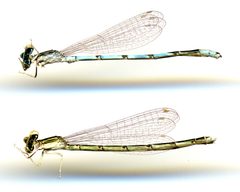
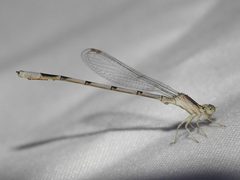
Enallagma basidens, commonly known as the Double-striped Bluet, is a of in the Coenagrionidae. measure 21–28 mm in length. The species is distinguished by a unique black shoulder stripe divided by a thin blue line, a feature found in no other damselfly. It occurs across North America and Middle America.
Pronunciation
How to pronounce Enallagma basidens: /ɛnəˈlæɡmə ˈbæsɪdɛnz/
These audio files are automatically generated. While they are not always 100% accurate, they are a good starting point.
Identification
The key identification feature is the peculiar black shoulder stripe, which is divided in two by a thin blue stripe. No other possesses a shoulder stripe with this appearance. This characteristic distinguishes E. basidens from all other damselflies, including other Enallagma species.
Images
Distribution
Present in North America and Middle America. Distribution records include the United States (including Vermont) and regions of Middle America.
Similar Taxa
- Enallagma civileBoth are small blue in the Enallagma, but E. civile (Familiar Bluet) lacks the divided black shoulder stripe characteristic of E. basidens. E. civile has a single, undivided shoulder stripe.
- Other Enallagma speciesMultiple Enallagma share general blue coloration and small size, but none possess the distinctive divided black shoulder stripe that is diagnostic for E. basidens.
More Details
Taxonomic Authority
Described by Calvert in 1902.
Sources and further reading
- BugGuide
- GBIF taxonomy match
- iNaturalist taxon
- NCBI Taxonomy
- Catalogue of Life
- Dragonfly Enthusiasts, Unite! Open House Set Nov. 6 at Bohart Museum | Bug Squad
- Know Your Dragonflies! | Bug Squad
- Dragonflies! Who Isn't Fascinated by Dragonflies? | Bug Squad
- Bohart Museum Open House: Dragonflies Rule! | Bug Squad
- Hooray for the red, white, and blue! Milkweed longhorned beetle, Tetraopes tetraophthalmus; dogbane tiger moth, Cycnia tenera; and familiar bluet, Enallagma civile — Bug of the Week
- Rising Temperatures Could Stunt Growth, Threaten Survival of Common Damselfly