
Argia moesta
(Hagen, 1861)
Powdered Dancer
Argia moesta, commonly known as the Powdered Dancer, is a in the Coenagrionidae native to North America. Mature males develop a distinctive pale blue pruinosity—a waxy, powdery coating—over their bodies. The species is notable for its year-round activity in parts of its range and its tendency to form oviposition , where females select -laying sites based on the presence and posture of conspecifics.
Pronunciation
How to pronounce Argia moesta: /ˈɑːr.d͡ʒi.ə ˈmoʊ.stə/
These audio files are automatically generated. While they are not always 100% accurate, they are a good starting point.
Identification
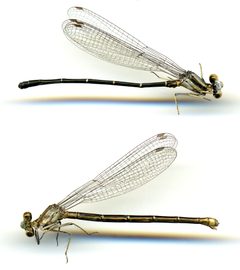
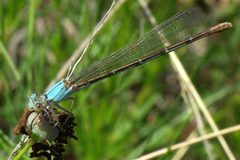
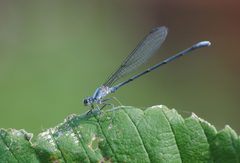
Mature males are covered in pale blue pruinosity, a waxy bloom that rubs off easily. This powdery coating distinguishes them from other Argia in their range. Females lack this pruinosity and are more cryptically colored. Like other dancers, the species exhibits a jerky, erratic pattern that contrasts with the direct flight of pond damselflies such as bluets and forktails. When perched, dancers typically rest with wings slightly raised above the rather than folded together.
Images
Habitat
Streams with vegetation suitable for oviposition, including sycamore leaves and other emergent or overhanging plants. perch on rocks, logs, and ground surfaces near water.
Distribution
Native to North America, with records from the United States and Middle America. Documented from Vermont westward and southward, with observations spanning multiple regions including the southwestern United States (e.g., New Mexico, Arizona).
Seasonality
Year-round activity reported in at least some portions of its range. Specific peak periods vary by latitude and local climate conditions.
Diet
Predatory; feeds on flying insects captured on the wing.
Behavior
Males and females form tandem pairs during oviposition, with the male contact-guarding the female. Females exhibit attraction when selecting oviposition sites, preferentially choosing locations where other pairs are already ovipositing in tandem posture rather than sites with uncoupled individuals or solitary males. This may reduce search costs and dilute risks of harassment and . perch on flat surfaces including ground, logs, and rocks, typically holding wings slightly elevated above the .
Ecological Role
of small flying insects; serves as prey for larger predators including birds, fish, and other aquatic and terrestrial predators. Oviposition may influence local resource distribution and microhabitat use in stream .
Human Relevance
Subject of behavioral research on oviposition site selection and attraction. Observed by enthusiasts and photographed as part of natural history documentation. Like other odonates, may serve as a bioindicator of stream health.
Similar Taxa
- Argia vividaBoth are North American Argia ; A. vivida males are bright blue without the pale pruinosity characteristic of mature A. moesta males. Females of both species are more difficult to distinguish and require careful examination.
- Other Argia speciesThe Argia contains approximately 114 in the Western Hemisphere; accurate identification often requires examination of male terminal appendages, color pattern details, and geographic range.
More Details
Research significance
A. moesta has been used as a model organism for studying attraction and social cues in oviposition site selection. Research demonstrates that posture (tandem vs. resting) serves as an important visual cue for females choosing where to lay .
Sources and further reading
- BugGuide
- GBIF taxonomy match
- iNaturalist taxon
- NCBI Taxonomy
- Catalogue of Life
- Dragonfly Enthusiasts, Unite! Open House Set Nov. 6 at Bohart Museum | Bug Squad
- Bohart Museum Open House: Dragonflies Rule! | Bug Squad
- Meloidae Holdings | Entomology Research Museum
- Flameskimmers Bring Great Joy | Bug Squad
- Quick! Find the Damselfly! | Bug Squad
- Bug Eric: New Mexico Dragonfly Blitz - Day 3
- Conspecifics and Their Posture Influence Site Choice and Oviposition in the DamselflyArgia moesta