
Amphiagrion abbreviatum
(Selys, 1876)
Western Red Damsel
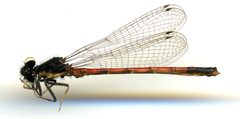
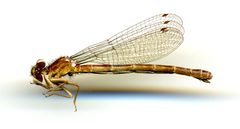
Amphiagrion abbreviatum, the western red damsel, is a in the Coenagrionidae. It exhibits unusual plasticity, occurring in both lentic and lotic freshwater systems. The shows distinct perching and roosting that differ from sympatric . It is widely distributed across western North America with stable .
Pronunciation
How to pronounce Amphiagrion abbreviatum: /ˌæm.fiˈæɡ.ri.ɒn əˌbri.viˈeɪ.təm/
These audio files are automatically generated. While they are not always 100% accurate, they are a good starting point.
Identification
Can be distinguished from the sympatric Argia vivida by association: A. abbreviatum occurs at open sites with available daytime perches, while A. vivida is associated with wooded areas. Roosting posture differs: A. abbreviatum perches lower at night with body held at a smaller angle to the substrate.
Images
Habitat
Geothermal springs, marshes fed by springs and seepage areas in arid regions, vegetated edges of ponds, lakes, and slow-moving streams. Recently documented in flowing riverine systems including gravel bars with slow but persistent current. Absent from heavily treed areas due to scarcity of suitable daytime perching sites.
Distribution
Western North America: British Columbia and northern prairies through 23 U.S. states to southwestern United States, Baja California, and one state in Mexico. Also recorded in Central America.
Behavior
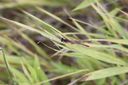
Roosts lower than Argia vivida at night, with body held at a smaller angle to the substrate. Absence from dense woodlands attributed to competitive pressure from A. vivida for limited perching sites. Reproductive activity documented in both lentic environments and lotic systems including gravel bars, emergent vegetation, and riparian grasses.
Similar Taxa
- Argia vividaFrequently co-occurs at geothermal springs but differs in abundance; requires trees for night roosting, occupies wooded sites, and exhibits competitive pressure for perching sites
Misconceptions
Long considered an exclusively lentic ; recent fieldwork has revealed reproductive in flowing riverine systems, indicating broader than previously assumed.
More Details
Conservation Status
IUCN Red List status: Least Concern (), reviewed 2017. stable with no immediate threats.
Habitat Plasticity
Unusual among Odonata in occupying both lentic and lotic systems; most specialize in one type.