
Calopteryx dimidiata
Burmeister, 1839
Sparkling Jewelwing
Calopteryx dimidiata, commonly known as the sparkling jewelwing, is a small to the eastern and southeastern United States. It is one of the smallest members of the Calopterygidae, measuring 37–50 mm in length. The species inhabits sandy forest streams with fast-flowing water, particularly acidic streams with abundant riverside vegetation. are active from spring through autumn depending on latitude, with males defending small territories and engaging in ritualized courtship .
Pronunciation
How to pronounce Calopteryx dimidiata: /kæˈlɑptərɪks dɪˌmɪdiˈɑːtə/
These audio files are automatically generated. While they are not always 100% accurate, they are a good starting point.
Identification
Distinguished from sympatric Calopteryx by: (1) male wings with black band terminating in straight line to nodus (not curved or irregular), (2) forewings and hindwings subequal in size (difference ≤2 mm), and (3) black sternum on tenth abdominal segment. These features separate it from C. maculata and other in its range. Females are more difficult to identify due to variable wing pigmentation and require examination of associated males or detailed morphological study.
Images
Appearance
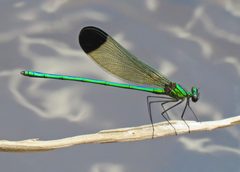
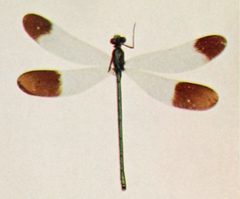
Total length 37–50 mm. and long slender metallic bluish-green; brown. Males: terminal fifth of each wing black with straight line separating dark section from transparent hyaline remainder; forewings and hindwings differ in size by no more than 2 mm; sternum of tenth abdominal segment black. Females: slightly more bronzy-green; wing pigmentation variable—may resemble male pattern but less defined, or only hindwings tipped with black, or wings entirely clear; small white pterostigma usually present near wing tip. Immatures: reddish eyes, duller coloration overall.
Habitat
Sandy forest streams with fast-flowing water, particularly acidic streams; requires locations with plentiful riverside vegetation. Found in woodland and open areas near forest rivers and streams.
Distribution
to eastern and southeastern United States. Range extends from New England to Louisiana and parts of Texas, primarily on the Atlantic coastal plain.
Seasonality
on wing May–September in New Jersey; February–November in Florida. Activity period varies with latitude, with longer season in southern portions of range.
Behavior
Males patrol small territories near breeding sites, circling and chasing off rivals. Ritualized courtship precede copulation when female present. Copulation lasts approximately two minutes. Female oviposits by down stem of emergent plant and remaining underwater approximately fifteen minutes to lay batch of several hundred before returning to surface. Both sexes often observed together near breeding sites.
Similar Taxa
- Calopteryx maculataOverlapping range; distinguished by male wing band with curved or irregular margin and different wing size proportions
- Calopteryx aequabilisSympatric in some areas; larger size and different wing pigmentation pattern
More Details
Taxonomic history
has been subject of taxonomic study examining morphological variability across its range; some geographic variation in wing pigmentation patterns documented
Conservation status
NatureServe records indicate is tracked for conservation status; specific rank not detailed in available sources
Sources and further reading
- BugGuide
- Wikipedia
- GBIF taxonomy match
- iNaturalist taxon
- NCBI Taxonomy
- Catalogue of Life
- Dragonfly Enthusiasts, Unite! Open House Set Nov. 6 at Bohart Museum | Bug Squad
- Pyromorpha dimidiata | Beetles In The Bush
- Variability, Distribution and Taxonomy of Calopteryx dimidiata (Zygoptera: Calopterygidae)
- Female and male interactions during courtship in Calopteryx maculata and C. dimidiata (Odonata: Calopterygidae): Influence of oviposition behaviour