
Tramea lacerata
Hagen, 1861
Black Saddlebags
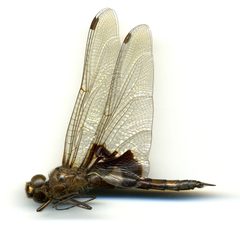
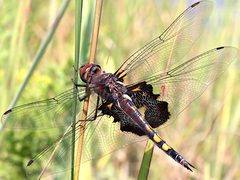
Tramea lacerata, commonly known as the Black Saddlebags, is a migratory skimmer found throughout North America. It is distinguished by prominent black blotches at the base of its hindwings that resemble saddlebags. The is one of five North American dragonflies targeted by the Migratory Dragonfly Partnership for citizen science monitoring due to its poorly understood patterns. are aerial that capture flying insects, while nymphs are aquatic predators in wetland .

Pronunciation
How to pronounce Tramea lacerata: /ˈtræ.miə ˌlæ.səˈrɑː.tə/
These audio files are automatically generated. While they are not always 100% accurate, they are a good starting point.
Identification
Images
Habitat
Associated with wetland including ponds, marshes, and other standing water bodies where nymphs develop. forage in open airspaces near these .
Distribution
North America, Middle America, Caribbean, and Oceania. Present throughout the continental United States, with migratory movements between northern breeding areas and southern sites.
Seasonality
Spring northward ; fall return to southern . Active present during warmer months; specific timing varies by latitude.
Diet
are aerial capturing flying insects including mosquitoes. Nymphs are aquatic predators of other insects in water.
Life Cycle
Hemimetabolous development with aquatic nymph stage and terrestrial/aerial stage. Nymphs are aquatic in wetlands; adults emerge and take .
Behavior
Migratory; travels north in spring and returns south in fall. are strong, agile fliers capable of precise aerial maneuvering using independently controlled four wings. Attracted to lights at night in some contexts, though primarily .
Ecological Role
Important in wetland controlling mosquito through both nymph and . Serves as prey for birds, fish, and frogs.
Human Relevance
Subject of citizen science monitoring through the Migratory Partnership to better understand patterns and inform conservation. Valued as a agent for mosquitoes.
Similar Taxa
- Tramea onustaRed Saddlebags shares similar wing pattern with black saddlebags markings, but differs in coloration of the saddlebags patch and overall body color.
- Anax juniusCommon Green Darner is another large migratory , but lacks the distinctive black wing blotches and has green with blue in males.