
Tramea darwini
Kirby, 1889
Striped Saddlebags
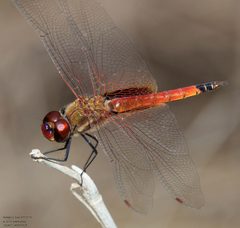
Tramea darwini is a in the Libellulidae, commonly known as the Striped Saddlebags. An insular has been documented exhibiting exceptional behavioral diversity in oviposition strategies, with four distinct modes recorded—more than any other studied population of the . This species belongs to a genus characterized by saddlebag-like markings on the hindwings.

Pronunciation
How to pronounce Tramea darwini: //ˈtræ.mi ə ˈdar.wɪˌni//
These audio files are automatically generated. While they are not always 100% accurate, they are a good starting point.
Identification
As a member of the Tramea, this likely displays the characteristic dark patches at the base of the hindwings that give saddlebags their . The specific epithet 'darwini' honors Charles Darwin, though this does not itself aid field identification. Distinguishing T. darwini from requires examination of wing venation, abdominal patterning, and the precise shape and extent of the hindwing patches. The common name 'Striped Saddlebags' suggests longitudinal striping on the that may separate it from other Tramea species.
Images
Habitat
Documented from pond on Isabela Island in the Galápagos, where an insular has been studied. GBIF records indicate presence in diverse Colombian departments including Antioquia, Chocó, and Vaupés, suggesting adaptability to varied Neotropical freshwater environments. The Vermont, USA record likely represents a vagrant or misidentification given the ' established Neotropical distribution.
Distribution
Primary distribution in northern South America, with confirmed records across numerous Colombian departments. The has been studied in detail from an insular in the Galápagos (Isabela Island). GBIF data indicate presence in the Caribbean region (Archipiélago de San Andrés, Providencia y Santa Catalina) and mainland South America. A single record from Vermont, USA is noted but its status as established population or vagrant is unclear.
Behavior
An insular Galápagos exhibits four distinct oviposition strategies: (1) tandem oviposition in tandem, (2) female oviposition alone, (3) female oviposition under non-contact guarding by male, and (4) other variants. The 'tandem–oviposition–tandem' mode—though most frequently observed—was found to be less efficient than solitary female oviposition or oviposition under non-contact guarding. This paradox suggests sexual conflict, with males and females favoring different behavioral strategies. This behavioral diversity exceeds that recorded for any other Tramea population studied.
Similar Taxa
- Tramea lacerataBlack Saddlebags shares the characteristic hindwing patches and overlapping North American/Neotropical range; requires careful examination of abdominal striping and wing patch for separation.
- Tramea onustaRed Saddlebags occurs in overlapping regions and similar ; reddish coloration and wing patch details differ from T. darwini.
- Brachymesia herbidaSympatric in Galápagos pond ; also exhibits multiple oviposition strategies though with lower behavioral diversity than T. darwini in the same insular .
More Details
Behavioral Diversity Significance
The four oviposition modes documented in the Galápagos insular represent the highest behavioral diversity recorded for any Tramea population. This challenges assumptions that -poor island exhibit reduced behavioral complexity, instead suggesting that underfilled behavioral may promote diversification of reproductive strategies.
Sexual Conflict
The documented inefficiency of the most common male-favored tandem strategy compared to female-favored alternatives provides empirical support for sexual conflict theory in odonate reproductive .
Sources and further reading
- BugGuide
- GBIF taxonomy match
- iNaturalist taxon
- Catalogue of Life
- Tom Seeley: 'Bees Are Superb Beekeepers' | Bug Squad
- Researcher Santiago Ramirez to Discuss Those Amazing Orchid Bees | Bug Squad
- Registration Underway for UC Davis Bee Symposium, Set Saturday, March 3 | Bug Squad
- Is Jade Lucky? Well, Bumble Bees Like It! | Bug Squad
- Why Aren't There More Women in Beekeeping? | Bug Squad
- Are You a Graduate Student Involved in Pollinator Research? | Bug Squad
- Behavioural diversity of an insular population of Tramea darwini, with notes on Brachymesia herbida and Erythemis vesiculosa (Odonata, Libellulidae)