
Pseudoleon superbus
(Hagen, 1861)
Filigree Skimmer
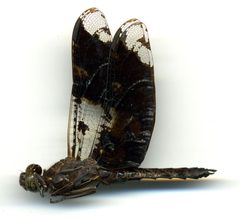
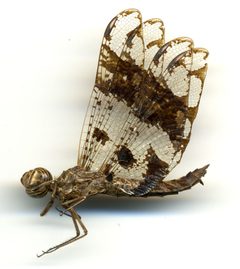
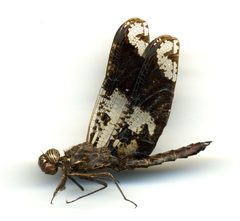
A subtropical in the Libellulidae and sole member of its . Males have predominantly blackish wings with distinctive filigree-like venation patterns; females display reduced black markings in a reticulated pattern. The species occupies a disjunct distribution, with core in the southwestern United States and Mexico, and scattered northern records including Colorado. It frequents rocky streams and rivers with slow to moderate current in open, often arid settings.
Pronunciation
How to pronounce Pseudoleon superbus: //ˌsjuː.dəʊˈliː.ɒn suːˈpɜː.bəs//
These audio files are automatically generated. While they are not always 100% accurate, they are a good starting point.
Identification
Distinguished from other Libellulidae by its unique wing venation: males have extensive black pigmentation on wings, especially hindwings, with delicate pale reticulations creating a filigree effect. Females show reduced black markings in an abstract, net-like pattern. Both sexes exhibit prominent longitudinal pale stripes on the . Body length 38–45 mm; hindwing length 30–35 mm. The Pseudoleon is , eliminating confusion with .
Images
Habitat
Rocky streams and rivers with slow to moderate current, typically in open settings. In the northern part of its range, associated with narrow riparian corridors through shortgrass prairie and degraded grasslands. Occupies canyon systems with permanent or semi-permanent water, including artificial ponds and modified stream channels.
Distribution
Primary range: southern and central Arizona, New Mexico, western and central Texas, and Mexico (including Oaxaca). Northern disjunct records: southwestern Missouri (Ozark region), Colorado (Colorado Springs area), and New Mexico (Lincoln County, ~7,500 ft elevation).
Seasonality
active mid-summer; Colorado records from early July. Missouri observations from early August.
Life Cycle
Females oviposit by hovering over water and dipping the tip into algal mats or detritus piles, depositing at least one per thrust. Larval development aquatic; specific instar details unreported.
Behavior
Males perch on rocks and vegetation along watercourses, making periodic patrol up and down stream corridors. When air temperatures rise, males assume an 'obelisk' posture with raised vertically to minimize sun exposure. Multiple males may occupy the same territory and engage in chasing interactions. Females are cryptic and less frequently observed; may disappear quickly after oviposition by landing on nearby substrates where heavily mottled wings provide camouflage.
Human Relevance
First Colorado state record (2014) and subsequent documentation (2016) represent significant northern range extensions for this subtropical . Records have been submitted to Odonata Central for verification and range mapping.
Similar Taxa
- Plathemis lydia (Common Whitetail)Similar perching and preference; distinguished by different wing pattern (broad black bands on outer wings in mature males, not extensive black with filigree venation) and lack of stripes.
- Libellula saturata (Flame Skimmer)Overlaps in southwestern ; Flame Skimmer males have bright orange-red body and wings with dark bases, not black wings with pale reticulations.
Sources and further reading
- BugGuide
- GBIF taxonomy match
- iNaturalist taxon
- NCBI Taxonomy
- Catalogue of Life
- Bug Eric: Filigree Skimmers Are Back
- Bug Eric: Filigree Skimmer State Record for Colorado
- Bug Eric: Fun With Austin Butterfly Forum
- Bug Eric: Can "Enting" Be a Thing?
- A “superb” southwestern Missouri cicada | Beetles In The Bush
- 2019 WGNSS Nature Photo Contest | Beetles In The Bush