
Libellula saturata
Uhler, 1857
Flame Skimmer, Firecracker Skimmer
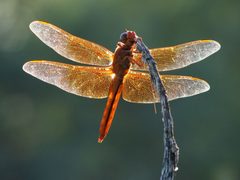
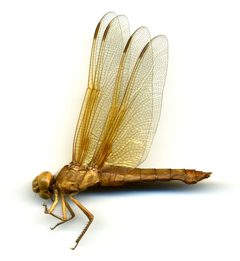
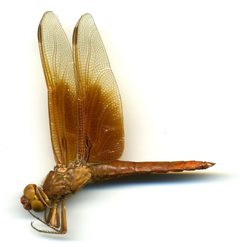
Libellula saturata, commonly known as the flame skimmer or firecracker skimmer, is a native to western North America. males display striking firecracker red to dark orange coloration, while females are medium to dark brown. The species exhibits pronounced in both size and color, with males reaching two to three inches in length and exceeding females in size. Research by UC Davis doctoral candidate Christofer Brothers has focused on this species to investigate predatory and leg in dragonflies.
Pronunciation
How to pronounce Libellula saturata: /lɪˈbɛluːlə ˌsætʃʊˈreɪtə/
These audio files are automatically generated. While they are not always 100% accurate, they are a good starting point.
Identification
Males are readily distinguished by their vivid red to orange coloration, contrasting with the brown females. The size difference between sexes is notable, with males substantially larger. The can be differentiated from other Libellula species by the combination of male coloration, body proportions, and geographic range. Close examination of wing venation and abdominal patterning may be necessary for definitive identification where ranges overlap with similar species.
Images
Appearance
males are firecracker red to dark orange in coloration. Females are medium to dark brown. Males measure approximately two to three inches in length and are larger than females. Like other , the possesses large containing up to 30,000 simple each, providing nearly 360-degree vision. are present but highly reduced. Wings are typical of the order Odonata. Nymphs are aquatic and possess modified mouthparts for .
Habitat
frequent ponds, streams, ditches, and other aquatic . Females oviposit in warm ponds and small streams. The nymphal stage is entirely aquatic, occurring in the same water bodies used by adults for .
Distribution
Native to western North America. Records indicate presence in Middle America and North America broadly.
Diet
capture bees, flies, , and other soft-bodied insects in , returning to perches to consume prey. Nymphs are ambush that feed on insect larvae including mosquitoes and aquatic flies, as well as small fish, tadpoles, and conspecifics.
Life Cycle
Development includes aquatic nymphal stages and terrestrial stages. Nymphs can live for extended periods, with some exhibiting nymphal durations up to eight years, though adult lifespan is typically brief, ranging from weeks to months. Females deposit in warm ponds or small streams. Nymphs undergo multiple instars before emerging as adults.
Behavior
employ two predatory strategies: active pursuit relying on speed or endurance, and sit-and-wait ambush tactics using stealth or surprise. Adults frequently perch near water and are not notably skittish, allowing close approach. Prey capture success in adult has been observed to reach 97 percent. Nymphs are ambush .
Ecological Role
Human Relevance
Featured in the 2014 Entomological Society of America calendar. Subject of ongoing behavioral research at UC Davis. Specimens displayed at the Bohart Museum of Entomology and the Vacaville Museum's 'Art of Death' exhibition. Nymphs may provide incidental mosquito control through on larval mosquitoes.
Similar Taxa
- Other Libellula speciesCongeneric may overlap in range and require examination of coloration, size, and wing venation for separation; male L. saturata distinguished by distinctive red-orange coloration
More Details
Research significance
Christofer Brothers, UC Davis doctoral candidate in the Stacey Combes laboratory, has selected this as a primary study organism for investigating the relationship between capture tools and behavioral tactics in , including phylogenetic comparisons of leg spine across species.
Sources and further reading
- BugGuide
- GBIF taxonomy match
- iNaturalist taxon
- NCBI Taxonomy
- Catalogue of Life
- The Wonder of Dragonflies | Bug Squad
- Bohart Bugs Beckon at Vacaville Museum's Exhibit | Bug Squad
- Don't Miss the Dragonfly Open House Nov. 6 at Bohart Museum of Entomology | Bug Squad
- 'It's One Universal Experience We All Wlll Share' | Bug Squad
- Dragonfly Enthusiasts, Unite! Open House Set Nov. 6 at Bohart Museum | Bug Squad
- Just Buggin' Ya | Bug Squad