
Pachydiplax longipennis
(Burmeister, 1839)
Blue Dasher
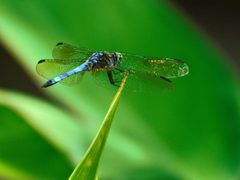
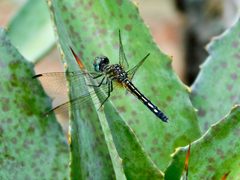
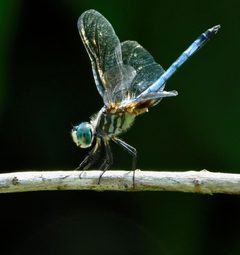
The Blue Dasher (Pachydiplax longipennis) is a common and widely distributed in the skimmer Libellulidae. It is the sole in its . are characterized by a blue , particularly in males, and are known as "perchers" that hunt from stationary positions. Males exhibit pronounced territorial at breeding and feeding sites, with social influencing patterns. The species occurs throughout North America and into the Caribbean.
Pronunciation
How to pronounce Pachydiplax longipennis: /ˌpækɪˈdɪplæks ˌlɒŋɡɪˈpɛnɪs/
These audio files are automatically generated. While they are not always 100% accurate, they are a good starting point.
Identification
Distinguished from similar skimmers by the combination of blue (males), yellow thoracic stripes, and brown-tinted wing bases. The Eastern Pondhawk (Erythemis simplicicollis) is larger with green and lacks the pronounced thoracic striping. The Blue Dasher is smaller and more slender than many Erythemis . Females may be confused with other striped skimmers but can be identified by the specific pattern of yellow thoracic stripes and wing venation.
Images
Appearance
have a slender body with large that nearly meet at the top of the . Males develop a distinctive blue (powdery) coating on the with age; females and immatures show greenish-yellow and black striping. The is brown with yellow lateral stripes. Wings are clear with a brownish tint at the base and along the leading edge. Body length ranges approximately 25-40 mm.
Habitat
Associated with still or slow-moving freshwater including ponds, lakes, marshes, and slow streams. Territorial males defend shoreline areas containing oviposition sites. Nymphs develop in aquatic environments with emergent vegetation. forage in open areas near water and may use artificial perch arrays in suitable habitats.
Distribution
Widely distributed across North America from southern Canada through the United States and into Mexico. Present in the Caribbean, including the Bahamas. Records from Vermont and throughout eastern, central, and western North America. Also reported from Middle America (Central America).
Seasonality
active from spring through fall, with peak activity during summer months. Seasonal decline in adult body size observed later in the breeding season. Specific timing varies with latitude.
Diet
are aerial capturing flying insects. Prey is captured during short from perches. Specific prey types include small flying insects, though detailed dietary analysis is not well documented in available sources.
Life Cycle
Hemimetabolous development with aquatic nymphal stage. deposited by females tapping the water surface, either in tandem with males or non-tandem. Nymphs are and occupy aquatic microhabitats. and period spans spring through fall. Multiple per year likely in southern portions of range.
Behavior
Males are territorial perchers that defend feeding and breeding sites through aerial pursuits and physical contact with intruders. Territorial tenure averages 1-2 days, maximum 7 days. Males exhibit site fidelity, returning to original territories after displacement. Agonistic comprise approximately 17% of all activities, with interaction frequency increasing at higher temperatures, solar radiation, prey , and density. Both sexes engage in intra- and interspecific aggression, though males show higher interaction rates and fighting success. Smaller males are frequently pursued and more likely to disperse when large males are present, suggesting as a subordinate tactic. Time allocated to agonistic behavior is limited (~19 seconds per 30-minute observation), with costs apparently outweighed by foraging benefits of favorable perches.
Ecological Role
aerial of small flying insects. Aquatic nymphs function as predators in freshwater . May serve as prey for larger odonates, birds, and other vertebrates. Contribution to services such as pest control not quantified in available sources.
Human Relevance
Subject of behavioral ecological research on territoriality, foraging, and social dominance. Common and conspicuous, making it accessible for citizen science observation and odonate monitoring programs. No documented economic importance or pest status.
Similar Taxa
- Erythemis simplicicollis (Eastern Pondhawk)Similar perching and use; distinguished by larger size, green , and less pronounced thoracic striping
- Erythemis simplicicollisBoth are "percher" with similar foraging strategies; Blue Dasher is smaller with distinct thoracic striping and wing base coloration
More Details
Behavioral Ecology Research
Pachydiplax longipennis has been extensively studied as a model organism for understanding territoriality, social dominance, and breeding in odonates. Research demonstrates that body size and competitive success influence male dispersal decisions, with important implications for understanding functional connectivity between .
Conservation Status
Not evaluated for conservation status; appears secure given wide distribution and abundance. No specific threats documented in available literature.
Sources and further reading
- BugGuide
- GBIF taxonomy match
- iNaturalist taxon
- NCBI Taxonomy
- Catalogue of Life
- An Introduction to Dragonflies and Spiders | Bug Squad
- Bug Spotlight | Entomology Research Museum
- Grasshoppers of Colorado
- Grasshoppers of Colorado
- Grasshoppers of Colorado
- Grasshoppers of Colorado
- A Study of Territoriality and Breeding Behavior in Pachydiplax longipennis Burmeister (Odonata:Libellulidae)
- Fights at the Dinner Table: Agonistic Behavior in Pachydiplax longipennis (Odonata: Libellulidae) at Feeding Sites
- Body size and social dominance influence breeding dispersal in male Pachydiplax longipennis (Odonata)
- Microhabitat selection as an antipredator strategy in the aquatic insect Pachydiplax longipennis Burmeister (Odonata: Libellulidae)
- A Comparison of Foraging Behavior in Two “Percher” Dragonflies, Pachydiplax longipennis and Erythemis simplicicollis (Odonata: Libellulidae)