
Pachydiplax
Brauer, 1868
Blue Dasher
Species Guides
1- Pachydiplax longipennis(Blue Dasher)
Pachydiplax is a of in the Libellulidae, containing at least one widespread North American , Pachydiplax longipennis (Blue Dasher). These dragonflies are medium-sized skimmers characterized by blue coloration in mature males. The genus is notable for extensive research on territorial , breeding , and agonistic interactions among males. Members are commonly found at freshwater across their range.
Pronunciation
How to pronounce Pachydiplax: //ˌpækɪˈdɪplæks//
These audio files are automatically generated. While they are not always 100% accurate, they are a good starting point.
Identification
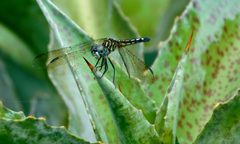
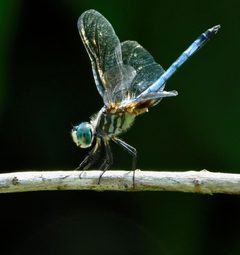
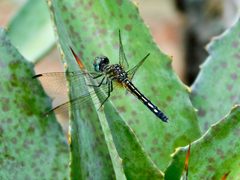
Distinguished from similar blue skimmers by the combination of: broad, flattened ; dark patches at wing bases (variable but common); relatively small size among Libellulidae; and perching on low vegetation or ground near water. Males can be separated from Erythemis simplicicollis by abdominal shape and wing pattern. The P. longipennis is the only member of the in North America, making genus-level identification straightforward in that region.
Images
Appearance
Medium-sized with slender bodies. Males develop bright blue coloration on the and with age, while females and immatures are brownish with yellow stripes. The are large and contiguous, covering most of the . Wings are clear with dark patches at the bases in some individuals. The abdomen is relatively broad and flattened compared to some other skimmers.
Habitat
Freshwater including ponds, lakes, marshes, and slow-moving streams. Often found in open, sunny areas with emergent vegetation. Breeding sites require water for larval development. perch on low vegetation, rocks, or bare ground near water edges.
Distribution
Widespread across North America from Canada to the southern United States and into the Bahamas. The has been recorded from Quebec (first Canadian record in 2011) southward throughout the eastern and central United States, and westward across the continent. The sole P. longipennis is one of the most broadly distributed in North America.
Seasonality
active from spring through fall, with peak activity in summer months. In temperate regions, season typically extends from May through September. Seasonal decline in adult body size has been documented, with larger individuals emerging earlier in the season.
Diet
are aerial capturing flying insects. Prey includes small flying insects such as mosquitoes, , and other soft-bodied arthropods. Nymphs are aquatic predators feeding on aquatic and small vertebrates.
Life Cycle
Hemimetabolous development with aquatic nymph stage and terrestrial stage. laid in or near water. Nymphs develop through multiple instars in aquatic , preying on other aquatic organisms. occurs at water's edge. Adults live for weeks to months, feeding, maturing, and reproducing.
Behavior
Males establish and defend breeding territories through aerial pursuits and physical contact. Territory size varies with structure. Males perch prominently to survey and defend territories. When large males are present, smaller subordinate males may disperse to other breeding sites. Agonistic interactions occur at both breeding and feeding sites. Copulation occurs in tandem, with males guarding females during oviposition. employ both sit-and-wait and active foraging strategies for prey capture.
Ecological Role
function as aerial controlling of small flying insects. Nymphs serve as predators in aquatic and as prey for larger aquatic predators including fish and other aquatic insects. The contributes to functional connectivity between aquatic through of adults and potentially nymphs.
Human Relevance
Subject of extensive behavioral and ecological research, particularly regarding territoriality and breeding systems. Frequently photographed by naturalists and featured in popular entomological media; a notable photograph of P. longipennis appeared in the Entomological Society of America's 2014 World of Insects calendar. Serves as an accessible study organism for and .
Similar Taxa
- Erythemis simplicicollis (Eastern Pondhawk)Similar size and coloration in males; distinguished by more slender , lack of wing base patches, and different perching
- Libellula speciesOther blue skimmers in same ; Pachydiplax generally smaller with broader, more flattened
More Details
Research significance
Pachydiplax longipennis has been extensively studied as a model organism for understanding territorial , breeding , and the relationship between body size and social dominance. Research has demonstrated that male body size influences competitive success and dispersal decisions, with smaller males more likely to disperse when large males are present.
Conservation note
The 2011 discovery of P. longipennis in Quebec represented a range extension and highlighted the value of ongoing odonate surveys for documenting distribution changes.
Sources and further reading
- BugGuide
- GBIF taxonomy match
- iNaturalist taxon
- NCBI Taxonomy
- Catalogue of Life
- An Introduction to Dragonflies and Spiders | Bug Squad
- Bug Spotlight | Entomology Research Museum
- Her Blue Dasher Is ESA's June Bug | Bug Squad
- Bug Squad
- The Joy of Dragonflies | Bug Squad
- Observations on Breeding Behavior of Pachydiplax Longfpennis (Odonata:Libellulidae)
- A Study of Territoriality and Breeding Behavior in Pachydiplax longipennis Burmeister (Odonata:Libellulidae)
- Body size and social dominance influence breeding dispersal in male Pachydiplax longipennis (Odonata)
- Microhabitat selection as an antipredator strategy in the aquatic insect Pachydiplax longipennis Burmeister (Odonata: Libellulidae)
- A Comparison of Foraging Behavior in Two “Percher” Dragonflies, Pachydiplax longipennis and Erythemis simplicicollis (Odonata: Libellulidae)
- Fights at the Dinner Table: Agonistic Behavior in Pachydiplax longipennis (Odonata: Libellulidae) at Feeding Sites
- Découverte de la libellule pachydiplax au Québec durant l’inventaire de l’odonatofaune du ruisseau Castagne en Montérégie