
Erythemis simplicicollis
(Say, 1840)
Eastern Pondhawk, Common Pondhawk
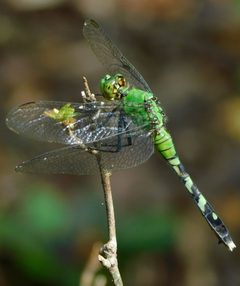
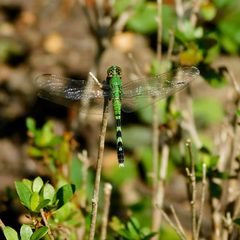
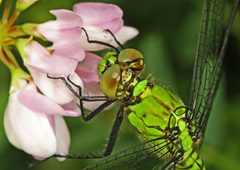
Erythemis simplicicollis is a widespread libellulid native to eastern North America and parts of Central America. exhibit strong : females remain bright green with banded , while mature males transition from green to blue and finally powdery bluish-grey. The occupies ponds and still waters, where males establish and defend territories over floating algal mats used for oviposition. It is an active aerial with documented sensitivity to environmental conditions including urban freshwater salinization.
Pronunciation
How to pronounce Erythemis simplicicollis: //ɛˈrɪθɛmɪs ˌsɪmplɪsɪˈkɒlɪs//
These audio files are automatically generated. While they are not always 100% accurate, they are a good starting point.
Identification
in coloration is distinctive: bright green females versus blue/green males. Distinguished from similar perching libellulids by larger average prey size and more frequent movement between broader, less structurally discrete perches compared to Pachydiplax longipennis. The combination of green with blue in mature males separates this from many other blue-bodied libellulids.
Images
Habitat
Ponds and still waters. Occupies both natural and urban freshwater environments, including wetlands subject to salinization from winter road salt .
Distribution
Eastern two-thirds of the United States, southern Ontario and Quebec in Canada, Bahamas, West Indies, Mexico, and Central America south to Rica. Widespread and abundant throughout range.
Seasonality
In Florida, new batches of emerge throughout summer months. Reproductive adult lifespan approximately ten days.
Diet
Aerial insect prey including and other flying insects. Mature individuals consume significantly larger prey on average than Pachydiplax longipennis, with gut contents comprising greater proportion of body mass. Nymphs function as in aquatic .
Life Cycle
Hemimetabolous with aquatic nymph stage and terrestrial stage. Final produces adult that transitions through color changes within hours. Under elevated conductivity/salinity conditions, timing accelerates and survival to emergence decreases. Males return to water after approximately two weeks post-emergence to establish territories.
Behavior
Athletic, swift-flying employing both active pursuit and sit-and-wait strategies. Forages from perches away from reproductive sites, moving frequently over larger areas than some . Males guard floating algal mats as oviposition sites, chasing rivals; satellite males remain nearby to intercept females or seize territories. Mating occurs on vegetation near water; female oviposits by dipping into water while male hovers guardedly.
Ecological Role
in aquatic and terrestrial ; prey for other predators. Salinization-induced shifts in timing create phenological mismatches and alter trophic interaction strength in freshwater .
Human Relevance
Subject of research on urban freshwater salinization effects. No documented direct economic or medical significance.
Similar Taxa
- Pachydiplax longipennisSimilar perching libellulid foraging ; distinguished by E. simplicicollis selecting broader perches, moving more frequently, capturing larger prey on average, and having lower feeding success rate
- Erythemis collocataWestern with similar (Western Pondhawk); distribution separates the two
More Details
Salinization Sensitivity
Experimental studies demonstrate that elevated conductivity from salt pollution decreases larval foraging rates and accelerates without affecting larval size or immune function. No carry-over effects to adult or immune strength were detected.
Foraging Ecology
Makes more frequent feeding than Pachydiplax longipennis but with substantially lower per-flight success rate, resulting in comparable overall prey capture rate.
Sources and further reading
- BugGuide
- Wikipedia
- GBIF taxonomy match
- iNaturalist taxon
- NCBI Taxonomy
- Catalogue of Life
- An Introduction to Dragonflies and Spiders | Bug Squad
- Lovin' the Lavender | Bug Squad
- A Comparison of Foraging Behavior in Two “Percher” Dragonflies, Pachydiplax longipennis and Erythemis simplicicollis (Odonata: Libellulidae)
- Urban freshwater salinization reshapes Erythemis simplicicollis (Odonata: Libellulidae) life history timing and predator–prey interactions