
Orthemis discolor
(Burmeister, 1839)
carmine skimmer, orange-bellied skimmer
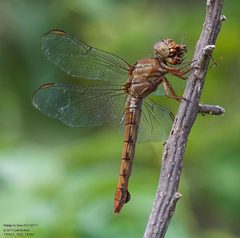
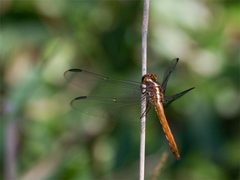
Orthemis discolor is a medium-sized in the skimmer Libellulidae, commonly known as the carmine skimmer or orange-bellied skimmer. It is widely distributed across the Americas, occurring from the southern United States through Central America to South America. The is listed as Least Concern by the IUCN with a stable . It is a to Orthemis ferruginea (roseate skimmer), with which it has been historically confused; the two are distinguished primarily by coloration and subtle structural differences in females.
Pronunciation
How to pronounce Orthemis discolor: /ɔrˈθɛmɪs ˈdɪskəlɔr/
These audio files are automatically generated. While they are not always 100% accurate, they are a good starting point.
Identification
Mature males distinguished from the closely related Orthemis ferruginea (roseate skimmer) by coloration: O. discolor males are carmine red rather than hot pink. Females of the two can be separated by a single structural characteristic (specific details not specified in available sources). Both sexes have the robust body form typical of the Orthemis.
Images
Distribution
North America, Middle America (Central America), and South America. Specific collection records include Misiones Province, Argentina (Santo Pipó, Parque Nacional Iguazú, María Magdalena) and Oaxaca, Mexico. The occurs throughout the Neotropical region and extends into the southern Nearctic.
Similar Taxa
- Orthemis ferruginea distinguished primarily by male coloration (hot pink in O. ferruginea versus carmine red in O. discolor); females separable by structural characteristics. The two overlap broadly in distribution across North and Middle America.
Sources and further reading
- BugGuide
- Wikipedia
- GBIF taxonomy match
- iNaturalist taxon
- NCBI Taxonomy
- Catalogue of Life
- Research Entomologist Daniel Hasegawa Targets Thrips | Bug Squad
- New Whirligig Beetle Showcases U.S. Biodiversity Hotspot
- Bug Eric: Bosque del Apache National Wildlife Refuge
- A new population of the federally-endangered decurrent false aster | Beetles In The Bush
- ID Challenge #22 | Beetles In The Bush
- Beleaguered boxwoods beware, box tree moth, Cydalima perspectalis, arrives in the DMV — Bug of the Week
- THE DISTRIBUTION AND RELATIVE ABUNDANCE OF THE SIBLING SPECIESORTHEMIS FERRUGINEA(FABRICIUS, 1775) ANDO. DISCOLOR(BURMEISTER, 1839) IN NORTH AND MIDDLE AMERICA (ANISOPTERA: LIBELLULIDAE)
- High karyotypic variation in Orthemis Hagen, 1861 species, with insights about the neo-XY in Orthemis ambinigra Calvert, 1909 (Libellulidae, Odonata)