
Orthemis
Hagen, 1861
Tropical King Skimmers
Species Guides
3- Orthemis discolor(carmine skimmer)
- Orthemis ferruginea(Roseate Skimmer)
- Orthemis
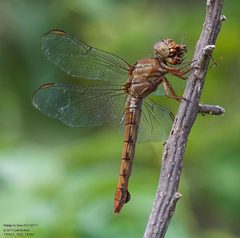
Orthemis is a of large in the Libellulidae, commonly known as Tropical King Skimmers. The genus is primarily Neotropical in distribution, with approximately 28 described . Males are typically red in coloration while females are brown. The genus exhibits notable chromosomal diversity, including the highest number recorded in Odonata (2n=41 in O. nodiplaga) and a neo-XY sex-determination system in O. ambinigra. The complete has been described for O. ferruginea, which includes 17 larval instars.
Pronunciation
How to pronounce Orthemis: //ˈɔr.θɛ.mɪs//
These audio files are automatically generated. While they are not always 100% accurate, they are a good starting point.
Identification
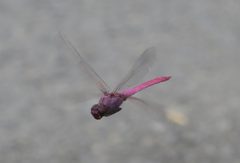
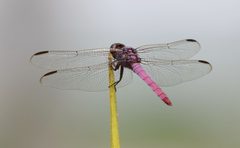
Males distinguished by generally red coloration; females by brown coloration. Specific identification to level requires examination of morphological details including abdominal patterning, wing venation, and in some cases chromosomal features. O. ferruginea males are notably hot pink in mature coloration. Females of O. ferruginea have a distinct flare near the tip of the and differ markedly from males in appearance.
Images
Habitat
Aquatic and semi-aquatic environments including marshes, wetlands, ponds, and temporary pools. O. schmidti larvae collected from small temporary muddy-bottomed puddles approximately 1.5 m × 1 m × 0.20 m deep. O. ferruginea found in muddy, shrinking wetlands.
Distribution
Neotropical region. Seven of 28 described reported from Argentina. Specific collection records from Misiones and Buenos Aires provinces (Argentina), Maranhão (northeastern Brazil), and New Mexico (USA) for O. ferruginea.
Diet
Larvae of O. ferruginea fed nauplii of Artemia franciscana during early instars (F-15 to F-8), and larvae of Culicidae and Chironomidae during later instars (F-7 to F-0).
Life Cycle
Complete with , larval (naiad), and stages. O. ferruginea has 17 larval instars from prolarva through F-0. Larval from F-0 to F-16 averaged 186 days under laboratory conditions (26-30°C). Eggs hatch in controlled conditions; larvae require aquatic environment. involves meiotic stages from spermatogonial prometaphase through metaphase II with characteristic including bouquet arrangement at early prophase I.
Ecological Role
Predatory as larvae, feeding on aquatic including mosquito and larvae. are aerial . O. schmidti larvae co-occurred with other Odonata including Erythrodiplax fusca, Pantala flavescens, Erythrodiplax basalis, Miathyria marcella, Orthemis discolor, Perithemis lais, and Erythemis plebeja.
Sources and further reading
- BugGuide
- Wikipedia
- GBIF taxonomy match
- iNaturalist taxon
- NCBI Taxonomy
- Catalogue of Life
- Bug Eric: Bosque del Apache National Wildlife Refuge
- Bug Eric: January 2016
- High karyotypic variation in Orthemis Hagen, 1861 species, with insights about the neo-XY in Orthemis ambinigra Calvert, 1909 (Libellulidae, Odonata)
- The life cycle of Orthemis ferruginea (Fabricius, 1775) (Odonata: Libellulidae)
- Description of the larva of Orthemis schmidti (Odonata, Libellulidae)