
Somatochlora margarita
Donnelly, 1962
Texas emerald
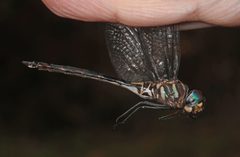
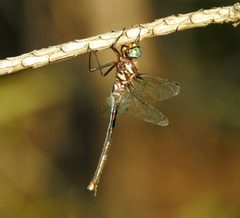
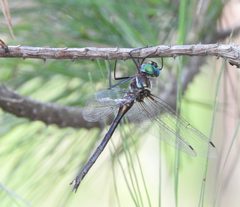
Somatochlora margarita, the Texas emerald, is a to the United States with a highly restricted range in eastern Texas and western Louisiana. It inhabits river systems and is rarely observed due to its habit of perching in forest . The was described by Donnelly in 1962 and is considered one of the more poorly known North American emeralds.
Pronunciation
How to pronounce Somatochlora margarita: /sɔmətoʊˈklɔrə mɑrgəˈrita/
These audio files are automatically generated. While they are not always 100% accurate, they are a good starting point.
Identification
Distinguished from other Somatochlora by its restricted geographic distribution in the Texas-Louisiana region. Separation from the more widespread Somatochlora tenebrosa (mocha emerald) and other sympatric emeralds requires examination of genitalic structures and detailed color pattern analysis. The combination of small size relative to some and specific preference for forested river systems may aid field identification where ranges overlap.
Images
Appearance
Medium-sized with total length 50–54 mm, length 32–41 mm, and hindwing length 32–37 mm. Like other Somatochlora , it has a metallic green body typical of the emerald dragonflies. Detailed color pattern descriptions are limited in available literature.
Habitat
Rivers, particularly those flowing through forested landscapes. Associated with riparian where perch in tree .
Distribution
to the United States. Known from 12 counties in eastern Texas and western and central Louisiana parishes. Current known range extends from northwest of Houston eastward to Alexandria, Louisiana. The has one of the most restricted ranges of any North American Somatochlora.
Behavior
are rarely seen by observers due to a pronounced tendency to fly up and perch in or on forest vegetation rather than remaining at accessible heights.
Human Relevance
Of interest to odonatologists and conservation biologists due to its restricted range and status. Listed as a of greatest conservation need in state wildlife action plans.
Similar Taxa
- Somatochlora tenebrosaOverlaps in general body plan and metallic green coloration; distinguished by different genitalic and broader eastern North American distribution extending well beyond the Texas-Louisiana region of S. margarita.
- Somatochlora provocansAnother southeastern US emerald with potential range overlap; separation requires detailed morphological examination and attention to specific wing venation and abdominal pattern differences.
More Details
Conservation status
The Texas emerald has been identified as a of greatest conservation need in state wildlife action plans, reflecting its restricted range and limited number of known .
Research needs
The larval stage was described by Abbott and Mynhardt in 2007, but much remains unknown about , specific requirements, and conservation needs.
Sources and further reading
- BugGuide
- Wikipedia
- GBIF taxonomy match
- iNaturalist taxon
- NCBI Taxonomy
- Catalogue of Life
- Is This Non-Native Mason Bee an Invasive Species?
- From the Lab to the Legislature and Living Room: Science Needs Storytellers
- Gulf of California | Blog
- crab species | Blog
- Hispanic Heritage Month: Publications Showcase
- What the Fossil Record Tells Us About Insect Extinctions in Deep Time