
Climacia areolaris
(Hagen, 1861)
spongillafly
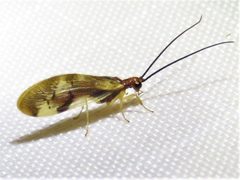
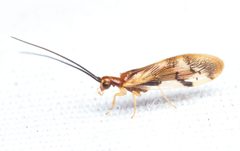
Climacia areolaris is a small spongillafly (Sisyridae) native to North America. measure slightly over 3 mm from to wingtips. The is distinguished from by wing pattern. It is active from March through December, with adults attracted to lights and feeding on pollen.
Pronunciation
How to pronounce Climacia areolaris: //klaɪˈmeɪʃə æˌriːəˈlɑːrɪs//
These audio files are automatically generated. While they are not always 100% accurate, they are a good starting point.
Identification
Distinguished from the two other Climacia in the United States by wing patterns. Both and larval keys exist for the three North American species. Larvae are identified by association with freshwater sponges and their distinctive stylet-like mouthparts.
Images
Habitat
Larvae inhabit freshwater streams, ponds, and lakes containing suitable of sponges. are terrestrial. A Pennsylvania study documented larvae at depths of 7.0–12.0 meters, with seasonal shifts in depth distribution.
Distribution
Eastern North America from Quebec and Nova Scotia south through the eastern United States to Florida; west to New Mexico; south into Mexican states of Tamaulipas and San Luis Potosí. New locality records include Otsego County, New York.
Seasonality
active from March to December. Larval densities highest in March through May in temperate lakes, declining with increasing summer temperatures.
Diet
Larvae feed on tissues of freshwater sponges including Spongilla fragilis, Spongilla lacustris, Meyenia subdivisa, Heteromeyenia ryderi, Trochospongilla horrida, and T. leidyi. feed on pollen.
Host Associations
- Spongilla fragilis - larval food sourcefreshwater sponge
- Spongilla lacustris - larval food sourcefreshwater sponge
- Meyenia subdivisa - larval food sourcefreshwater sponge
- Heteromeyenia ryderi - larval food sourcefreshwater sponge
- Trochospongilla horrida - larval food sourcefreshwater sponge
- Trochospongilla leidyi - larval food sourcefreshwater sponge
- Sisyridivora cavigena - pteromalid parasitizing pupal stage and last instar larvae during
Life Cycle
laid on objects near or overhanging water. Larvae complete development within freshwater sponge tissues, using stylet-like mouthparts to pierce and feed on sponge material. Third instar larvae exit water, spin protective nets, then cocoons up to 50 feet from shore for . Complete .
Behavior
Larvae construct portable silk cases within sponge tissues. Seasonal microhabitat shifts documented: larvae more abundant in shallower depths (7.0–9.0 m) during cooler months, shifting to deeper waters as temperatures rise. attracted to lights.
Ecological Role
Specialized associate of freshwater sponges, functioning as commensal or mildly parasitic. Contributes to nutrient cycling in freshwater sponge .
Human Relevance
Subject of ecological and genetic research; Y evolutionarily lost in males, making it a model for cytological studies.
Similar Taxa
- Climacia sp. (other two US species)Distinguished by wing patterns; keys available for both and larvae
Misconceptions
Originally described as a of freshwater sponges, but more accurately functions as a commensal or mildly parasitic associate. were historically thought to feed, but possess atrophied mouthparts and are non-feeding.
More Details
Genetic peculiarity
Males have evolutionarily lost the Y , a trait documented by Hughes-Schrader in cytological studies.
Parasitism
The pteromalid Sisyridivora cavigena parasitizes both pupal stage and last instar larvae during .
Sources and further reading
- BugGuide
- Wikipedia
- GBIF taxonomy match
- iNaturalist taxon
- NCBI Taxonomy
- Catalogue of Life
- The Life History of Climacia areolaris (Hagen), a Neuropterous 'Parasite' of Fresh Water Sponges
- Distribution of Sisyridae and Freshwater Sponges in the upper-Susquehanna Watershed, Otsego County, New York with a New Locality for Climacia areolaris (Hagen)
- Temporal changes in temperature may suggest microhabitat shifts in larval spongillafly Climacia areolaris Hagen (Neuroptera: Sisyridae) abundance and density in a temperate freshwater lake