
Dicromantispa sayi
(Banks, 1897)
Say's mantidfly
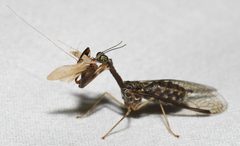
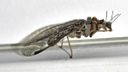
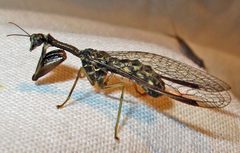
Dicromantispa sayi, commonly known as Say's mantidfly, is a small predatory insect in the Mantispidae. measure 14–15 mm and are recognized by their forelegs resembling those of praying mantises. The exhibits distinct in coloration, with females typically darker than males. It is found across North America, Central America, and the Caribbean, where it inhabits forest edges and prairies. Adults are active from mid-July through early September, peaking at the end of July. The species has a specialized in which larvae are obligate of spider .
Pronunciation
How to pronounce Dicromantispa sayi: //daɪ.kroʊˈmæn.təs.pə ˈseɪ.i//
These audio files are automatically generated. While they are not always 100% accurate, they are a good starting point.
Identification
Distinguished from Dicromantispa interrupta by smaller size and absence of dark patch near wing tip. Distinguished from Leptomantispa pulchella by abdominal pattern: D. sayi has uneven-width yellow stripes down sides of , while L. pulchella has paired, even-width yellow stripes. L. pulchella also has bright burnt orange wing stigma versus dark brown in D. sayi. Clear wings with brown and no brown spots at wing tips; base and outer edge of wings ( area) dark brown with faint yellowish streak.
Images
Habitat
Forest edges and prairies where spiders are present. Requires supporting spider for larval development.
Distribution
North America, Central America, and Caribbean Sea region. Records include United States (including Vermont), Mexico, and Caribbean islands.
Seasonality
period from July 15 to September 4, with peak activity at the end of July. Single per year.
Diet
feed on small flying insects. Larvae are obligate of spider , with documented including wolf spiders (Lycosidae) and the running crab spider Philodromus vulgaris.
Host Associations
- Lycosidae - Wolf spiders serve as ; larvae penetrate sacs or hitchhike on females
- Philodromus vulgaris - Running crab spider, documented for larval development
Life Cycle
Females lay on any substrate. Larvae hatch and wander to locate spider egg sacs, either penetrating sacs directly or hitchhiking on female spiders to access eggs. First instar larvae overwinter. One per year.
Behavior
are and attracted to lights. Front legs typically folded and not used except for capturing prey. Larvae exhibit phoretic , riding on female spiders to reach sacs.
Ecological Role
function as of small flying insects. Larvae are specialized /predators of spider , potentially regulating spider . Documented for research on developmental of mantidflies.
Human Relevance
Subject of entomological research, particularly regarding larval and associations. Occasionally encountered by blacklight collectors. No significant economic impact.
Similar Taxa
- Dicromantispa interruptaLarger with dark patch near wing tip; D. sayi lacks this patch and is smaller
- Leptomantispa pulchellaHas paired, even-width yellow abdominal stripes versus uneven stripes in D. sayi; bright burnt orange wing stigma versus dark brown in D. sayi
More Details
Type specimen
Lectotype male (as Mantispa sayi) designated by Banks, 1897; type locality Brazos County, Texas; deposited in Museum of Comparative Zoology, Harvard University. Additional syntype material includes lectotype of Mantispa fuscicornis (Kissimmee, Florida) and of Mantispa uhleri (Pennsylvania), now synonymized.
Research history
has been subject of developmental studies, including work by Redborg and MacLeod (1985) on Mantispa uhleri (now D. sayi). Documented as of Sosippus texanus wolf spiders in Texas.
Sources and further reading
- BugGuide
- Wikipedia
- GBIF taxonomy match
- iNaturalist taxon
- NCBI Taxonomy
- Catalogue of Life
- From Caterpillars to Butterflies to Chronic Pain Research | Bug Squad
- Bruce Hammock: From ResearchIng Insect Science to Researching Autism and Schizophrenia | Bug Squad
- Bug Eric: Last Night to Blacklight?
- Bug Eric: Stop Saying the Monarch is a "Gateway Species" for an Appreciation of Other Insects
- Bug Eric: Spider Sunday: Funnel-web Wolf Spiders
- Termite Experts Attempt to Solve Taxonomic Cold Cases