
Panorpa galerita
Byers, 1962
Hooded Scorpionfly, Common Scorpionfly
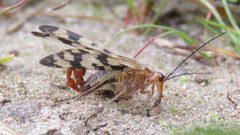
Panorpa galerita is a of in the Panorpidae, described by George Byers in 1962. It is found in North America, with records from the northeastern United States including Vermont. As a member of the Panorpa, it shares the characteristic elongated rostrum and, in males, enlarged genital claspers that give scorpionflies their . The species is part of the diverse Mecoptera order, which includes approximately 600 species worldwide.
Pronunciation
How to pronounce Panorpa galerita: //pəˈnɔːrpə ɡæˈlɛrɪtə//
These audio files are automatically generated. While they are not always 100% accurate, they are a good starting point.
Identification
Identification to level within Panorpa requires examination of male genitalia, specifically the structure of the claspers and associated parameters. P. galerita is distinguished from by subtle differences in these structures and likely by the "hooded" appearance referenced in its specific epithet. Wing banding patterns may provide preliminary clues but are variable and overlap among species. The species occurs in the northeastern United States, which may help narrow possibilities when combined with morphological examination.
Images
Habitat
Dense, moist woodland , particularly wet bottomland forests. Scorpionflies in this are typically associated with shaded, humid environments with abundant leaf litter and decaying organic matter.
Distribution
North America; specifically recorded from the northeastern United States including Vermont. The ' range appears to be more restricted than some widespread such as P. helena or P. nuptialis.
Seasonality
active in spring and early summer. Based on related , likely emerges in April–June, with peak activity depending on local climate conditions.
Behavior
Scorpionflies are known for their nervous, flitting through dense vegetation when disturbed. Males use their enlarged genital claspers during mating. Both sexes are scavengers, feeding on dead or dying soft-bodied insects, and have been observed stealing prey from spider webs.
Ecological Role
Scavenger in forest , contributing to nutrient cycling by consuming dead insects. May serve as prey for various including spiders, birds, and small mammals. Recent studies indicate scorpionflies (including related ) can be early colonizers of carrion, potentially expanding their known ecological role.
Human Relevance
Of minor direct importance to humans. Related have been documented in contexts as early arrivals at cadavers, suggesting potential utility in forensic investigations. The order Mecoptera is of scientific interest as a basal group of holometabolous insects with phylogenetic significance.
Similar Taxa
- Panorpa helenaWidespread with similar wing banding and preferences; distinguished by male genitalia structure and specific wing pattern details
- Panorpa nuptialisAnother common North American ; differs in distribution (more southern) and male genital
- Panorpa acutaCommon scorpionfly with overlapping range; separation requires examination of male claspers and paramere structure
More Details
Taxonomic Authority
Described by George W. Byers in 1962, a leading on Mecoptera who produced extensive revisions of North American .
Etymology
The specific epithet "galerita" derives from Latin, meaning "wearing a cap" or "hooded," likely referring to a distinctive or pronotal structure.
Conservation Status
Not evaluated; appears to be naturally uncommon with restricted distribution compared to more widespread .
Sources and further reading
- BugGuide
- Wikipedia
- GBIF taxonomy match
- iNaturalist taxon
- NCBI Taxonomy
- Catalogue of Life
- Panorpidae | Beetles In The Bush
- Forensic Entomology is More than Just Blow Flies and Beetles
- May | 2012 | Beetles In The Bush | Page 2
- One-shot Wednesday | Beetles In The Bush
- Bug Eric: January 2012
- Archives | Beetles In The Bush