
Dinokanaga dowsonae
Archibald, 2005
Dinokanaga dowsonae is an extinct of described from Eocene fossil deposits in British Columbia, Canada. It belongs to the Dinopanorpidae, a group of large-bodied mecopterans known from the Paleogene of North America and Asia. The species was named by paleoentomologist S. Bruce Archibald in 2005 based on well-preserved wing specimens. Like other dinopanorpids, it represents part of the diverse insect fauna that inhabited warm temperate forests during the early Cenozoic.
Pronunciation
How to pronounce Dinokanaga dowsonae: //ˌdaɪnoʊˈkænəɡə ˈdaʊsəˌni//
These audio files are automatically generated. While they are not always 100% accurate, they are a good starting point.
Identification
Distinguished from other Dinokanaga by specific wing venation characters including details of radial sector branching and crossvein . Differs from the co-occurring Dinokanaga andersoni in forewing shape and precise venation patterns. Separable from other dinopanorpid by the combination of costal area width, position of fork R4+5, and arrangement of medial crossveins. Identification requires examination of well-preserved wing specimens with visible venation.
Images
Appearance
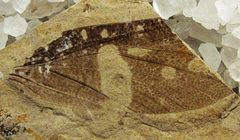
Known from fossil wing impressions showing the characteristic venation pattern of Dinopanorpidae. Wings were large and broad with dense, complex venation including numerous crossveins. The is distinguished by forewings with a notably widened costal area and distinctive branching patterns in the radial and medial . Body size is inferred to have been relatively large compared to extant Mecoptera, consistent with other dinopanorpid .
Habitat
Inferred from associated paleofloral indicating warm temperate to subtropical broadleaf forest with abundant moisture. The Okanagan Highlands Eocene deposits preserve lacustrine shales deposited in or near forested lake margins. Climate reconstructions suggest mean temperatures substantially warmer than present-day British Columbia.
Distribution
Known only from the Eocene Okanagan Highlands of British Columbia, Canada, specifically from the McAbee Fossil Beds near Cache Creek. This locality has yielded exceptionally preserved compression fossils of diverse insect and plant .
Human Relevance
Contributes to understanding of Eocene biodiversity and paleoclimate in western North America. The Okanagan Highlands fossil sites, including the type locality, are significant for paleontological research and heritage conservation. The name honors a contributor to fossil site documentation.
Similar Taxa
- Dinokanaga andersoniCo-occurring congeneric from the same deposits, distinguished by forewing proportions and venation details
- DinopanorpaRelated in same with similar large size and wing shape, separable by specific venation characters including medial system organization
- OrthophlebiaExtinct mecopteran with convergent large wing size but belonging to different (Orthophlebiidae), differs in venation pattern and wing base structure
More Details
Fossil preservation
Specimens preserved as compression fossils in fine-grained lacustrine shales of the Eocene Kamloops Group. Wing venation is the primary diagnostic feature due to preservation limitations.
Eocene Okanagan Highlands
The type locality represents one of the most diverse Eocene fossil biotas in North America, preserving a forest that existed shortly after the Paleocene-Eocene Thermal Maximum.