
Procridinae
Grisebach
Forester Moths
Genus Guides
9- Acoloithus
- Harrisina(grapeleaf skeletonizer moths)
- Neoalbertia
- Neofelderia
- Neoilliberis
- Neoprocris
- Pyromorpha(orange-patched smoky moths)
- Tetraclonia
- Triprocris
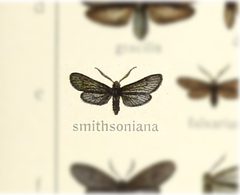
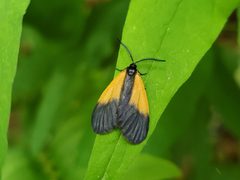
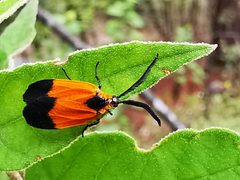
Procridinae is a of Zygaenidae commonly known as foresters. All Australian belong to this subfamily, which includes moths with aposematic coloration and chemical defense capabilities. The group is taxonomically challenging, with genital examination often required for species identification in Europe. Members exhibit specialized herbivory with documented plant associations including Hibbertia (Dilleniaceae) and Achillea (Asteraceae).
Pronunciation
How to pronounce Procridinae: //prɒˈkrɪdɪniː//
These audio files are automatically generated. While they are not always 100% accurate, they are a good starting point.
Identification
Identification of most European requires examination of genital structures. is used in taxonomic revisions of certain such as Pollanisus. Male and female genitalia serve as primary diagnostic characters for distinguishing species.
Images
Distribution
Worldwide distribution with strong representation in Australia, where all native Zygaenidae belong to this . Documented in Europe including Croatia, with range expansions recorded for multiple . Australian Pollanisus. Korean fauna includes 10 species of Illiberis. Present in North America including Florida.
Host Associations
- Hibbertia - plantDilleniaceae , newly reported for Pollanisus in Australia
- Achillea leptophylla - larval plantAsteraceae documented as for Jordanita (Roccia) volgensis in Crimea
Behavior
activity pattern. Aposematic coloration including iridescent green colors and -like appearance in many Australian . Chemical defense via of cyanogenic glucosides from plants, with ability to release prussic (hydrocyanic) acid. Larvae exhibit -flinging .
Similar Taxa
- ZygaeninaeOther of Zygaenidae; Procridinae distinguished by morphological and biogeographic patterns, with all Australian Zygaenidae belonging to Procridinae
More Details
Taxonomic difficulty
The is generally perceived as a difficult group for identification, particularly in Europe where genital examination is needed for most . This has resulted in historically scarce and limited published records for many regions.
Australian diversity
Australia 10 and 43 of Procridinae, including 4 genera and 21 species new to science as documented in comprehensive faunistic treatments. Many feature distinctive iridescent green coloration.
Sources and further reading
- BugGuide
- Wikipedia
- iNaturalist taxon
- NCBI Taxonomy
- Catalogue of Life
- Contribution to the Procridinae (Lepidoptera: Zygaenidae) fauna of Croatia
- Revision of the genus Pollanisus Walker, 1854(Lepidoptera: Zygaenidae: Procridinae)
- Laurelcherry Smoky Moth, Neoprocris floridana Tarmann 1984 (Insecta: Lepidoptera: Zygaenoidea: Zygaenidae: Procridinae)
- Zygaenid Moths of Australia
- New data on the distribution and biology of Jordanita (Roccia) volgensis (Möschler, 1862) (Lepidoptera: Zygaenidae, Procridinae) in the Crimea
- A Taxonomic Revision of Illiberis Walker (Lepidoptera: Zygaenidae: Procridinae) in Korea