
Harrisina
Packard, 1864
grapeleaf skeletonizer moths
Species Guides
3- Harrisina americana(Grapeleaf Skeletonizer Moth)
- Harrisina coracina
- Harrisina metallica(Western Grapeleaf Skeletonizer Moth)
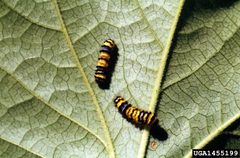
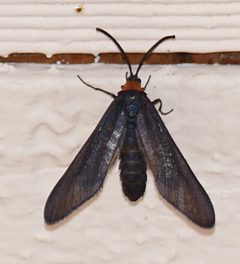
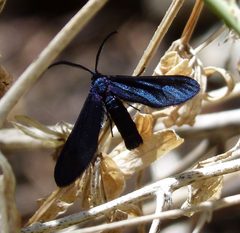
Harrisina is a of in the Zygaenidae, commonly known as grapeleaf skeletonizer moths. The genus includes several , notably Harrisina americana (grapeleaf skeletonizer) and Harrisina metallica (western grapeleaf skeletonizer), which are significant agricultural pests of grapevines. Members of this genus are characterized by their aposematic coloration—typically black with bright red or metallic markings—and their ability to produce hydrogen cyanide as a chemical defense. The larvae feed gregariously on grape foliage, skeletonizing leaves by consuming the tissue between the .
Pronunciation
How to pronounce Harrisina: //həˈrɪsɪnə//
These audio files are automatically generated. While they are not always 100% accurate, they are a good starting point.
Identification
Harrisina are distinguished from other Zygaenidae by their specific association with grapevines (Vitis spp.) and related plants, combined with their distinctive aposematic coloration of black with red or metallic markings. The bright red collar of male Harrisina americana is diagnostic for that . They may be confused with or net-winged beetles (Lycidae) due to convergent aposematic coloration, but can be separated by their moth-like wing venation, resting posture, and structure. Harrisina metallica specifically mimics spider wasps (Pompilidae) in coloration. Within the , species identification requires examination of genitalia and detailed pattern differences.
Images
Habitat
Primarily associated with vineyards, riparian corridors, and woodland edges where plants grow. Found in agricultural settings where grapes are cultivated, as well as natural supporting native Vitis and related plants such as Virginia creeper (Parthenocissus quinquefolia).
Distribution
North America, with ranging from the eastern United States (Harrisina americana) to western North America (Harrisina metallica). Some species extend into Mexico (Harrisina guatemalena, Harrisina rumelii, Harrisina brillians in northwestern Mexico and Zacatecas). Specific distribution records exist for Vermont, Texas, and Oklahoma.
Diet
Larvae feed on grape leaves (Vitis spp.) and related plants in the Vitaceae, including Virginia creeper (Parthenocissus quinquefolia). They skeletonize leaves by consuming the tissue between the , leaving a lace-like structure. Feeding is gregarious, with multiple larvae often found on the same leaf.
Host Associations
- Vitis - larval plantBoth wild and cultivated grape
- Parthenocissus quinquefolia - larval plantVirginia creeper, alternative
Life Cycle
Complete with , larval, pupal, and stages. Larvae are caterpillars that feed gregariously on foliage, skeletonizing leaves. occurs in sheltered locations. Specific details on egg-laying , number of per year, and stage vary by and are not fully documented for the as a whole.
Behavior
Larvae feed gregariously in groups on leaves, producing characteristic skeletonized damage. are and active during daylight hours, unusual for . When disturbed, both larvae and adults can produce hydrogen cyanide as a chemical defense—a trait shared with other Zygaenidae. Adults visit flowers for nectar. Some exhibit -mimicry in and appearance, particularly Harrisina metallica which resembles spider wasps.
Ecological Role
Larvae function as herbivores on grape plants. In natural , they likely serve as food for and , though their chemical defenses provide protection. In agricultural settings, several are significant pests of grape production. They serve as for parasitoid , with documented parasitoid complexes in Mexico.
Human Relevance
Several are economically important agricultural pests of grapes, particularly Harrisina americana in eastern North America and Harrisina metallica in western regions. Larval feeding damage can reduce grape yields and vine vigor. The bright coloration and activity of can cause them to be mistaken for . They have been studied for their chemical defense mechanisms and as subjects of mimicry research.
Similar Taxa
- Alypia octomaculataAlso feeds on grape plants and has similar , but belongs to family Noctuidae and has distinct wing pattern of white spots on black background
- Sesiidae (clearwing moths)Some sesiid mimics resemble Harrisina in coloration and activity, but have clear wings with reduced scaling and different body proportions
- Lycidae (net-winged beetles)Convergent aposematic coloration with red/black or orange/black patterns; some Zygaenidae specifically mimic this , but beetles have hardened forewings () and different
- Pompilidae (spider wasps)Harrisina metallica specifically mimics these in metallic blue-black coloration and ; wasps have a constricted waist and different wing venation
More Details
Chemical Defense
in this are among the few insects capable of producing hydrogen cyanide (HCN) as a defense compound. This is a derived trait within Zygaenidae and serves as an effective deterrent against .
Taxonomic History
The was established by Packard in 1864. have been described from 1832 (H. americana) through the early 20th century, with most North American species described by 1910.
Sources and further reading
- BugGuide
- Wikipedia
- GBIF taxonomy match
- iNaturalist taxon
- NCBI Taxonomy
- Catalogue of Life
- Bug Eric: Wasp Wednesday: Not Wasp VIII
- 2019 Arkansas/Oklahoma Insect Collecting Trip iReport | Beetles In The Bush
- Sphingidae | Beetles In The Bush | Page 2
- Parasitoids associated with the grape leaf skeletonizer, (Harrisina brillians1) in Zacatecas, Mexico
- Parasitoids of the grapeleaf skeletonizer, Harrisina brillians Barnes and McDunnough (Lepidoptera: Zygaenidae) in northwestern Mexico