
Monema flavescens
Walker, 1855
Oriental moth
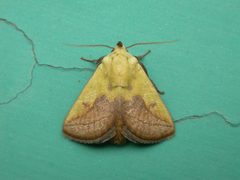
Monema flavescens is a medium-sized in the Limacodidae (slug moths or cup moths), native to East Asia. exhibit yellowish coloration typical of the , with males having a wingspan of 30–32 mm and females 35–39 mm. The larvae are defoliators of broadleaf trees, bearing urticating spines that can affect human health. The has one to two per year depending on region, with adults active from late June to August. It has been introduced to Massachusetts, USA, and is considered a potential pest for Europe.
Pronunciation
How to pronounce Monema flavescens: /moˈneːma flaˈwɛskɛns/
These audio files are automatically generated. While they are not always 100% accurate, they are a good starting point.
Identification
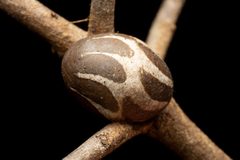
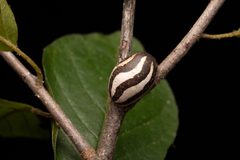
can be distinguished from other Monema by morphological taxonomic keys and . The species has been historically confused with M. meyi and other congeneric species in China, requiring revision of prior biological studies. Larvae are recognized by their flattened, slug-like form with suckers rather than legs, and the presence of urticating spines. The ovoid cocoons are formed at junctions between twigs and branches or on tree trunks.
Images
Appearance
are medium-sized yellowish . Males have wingspan 30–32 mm; females 35–39 mm. The exhibits the characteristic yellow coloration of the Monema. Larvae are flattened and slug-like, with suckers instead of true legs for locomotion, and bear urticating spines. They produce a lubricating liquid silk to aid movement.
Habitat
Broadleaf forests and ornamental plantings. Larvae feed on plant leaves; occurs in ovoid cocoons located at twig/branch junctions or on tree trunks.
Distribution
Native to East Asia: Japan, Korea, Russian Far East (Amur, Ussuri, Askold), China (Heilongjiang, Jilin, Liaoning, Inner Mongolia, Beijing, Hebei, Shandong, Henan, Shaanxi, Qinghai, Jiangsu, Shanghai, Zhejiang, Hubei, Jiangxi, Fujian, Guangdong, Guangxi), Taiwan, Philippines, India (Hyderabad, Kerala), Bhutan, and Nepal. Introduced to USA (Massachusetts).
Seasonality
emerge from late June to late August. One per year in USA (adults June–July, cocoons August–October, May); two generations in Japan (first generation adults June, second mid–late August).
Diet
on broadleaf trees. Young larvae graze undersides of leaves; older larvae skeletonize leaves, consuming all tissue except main . Documented on 51 plant in 24 including Acer, Betula, Castanea, Celtis, Diospyros, Juglans, Malus, Platanus, Populus, Prunus, Pyrus, Quercus, Rhamnus, Salix, Ulmus, and Zelkova.
Host Associations
- Acer palmatum -
- Acer platanoides -
- Acer pseudoplatanus -
- Betula lenta -
- Betula nigra -
- Castanea crenata -
- Castanea sativa -
- Celtis spp. -
- Diospyros kaki -
- Diospyros malabarica -
- Gleditsia triacanthos -
- Juglans regia -
- Malus spp. -
- Platanus spp. -
- Populus spp. -
- Prunus spp. -
- Pyrus spp. -
- Quercus acutissima -
- Quercus serrata -
- Quercus variabilis -
- Rhamnus spp. -
- Salix chaenomeloides -
- Ulmus spp. -
- Zelkova serrata -
- Ziziphus jujuba -
- Chrysis shanghalensis - Larval ectoparasitoid (Chrysididae)
- Eurytoma monemae - Potential for (Eurytomidae)
Life Cycle
Four stages: , larva, pupa, . Females lay 500–1000 eggs in groups on undersides of leaves. Eggs hatch in approximately one week. Larvae undergo 6–8 instars, feeding on leaf tissue. occurs in spring, with adults emerging in summer. occurs as fully grown larva or in ovoid cocoons. Development from egg to adult takes approximately six weeks under favorable conditions.
Behavior
are and fly only short distances; capacities are otherwise unknown. Females exhibit distinct diel periodicity in calling , with peak calling at 97.8% in 2-day-old females. Calling onset advances with age: 1-day-old females call 4 hours after scotophase onset, while 5–6 day old females call during the first hour. Males are sexually mature on the third night after , females on the second night. Highest mating success occurs for 3-day-old virgin females 4–6 hours after scotophase onset. Field tests confirm males are preferentially attracted to 2–3 day old virgin females. Larvae move by rolling waves using suckers rather than with individual legs, aided by liquid silk lubricant.
Ecological Role
Human Relevance
Significant forestry pest causing defoliation of ornamental and forest trees. Larval urticating spines can cause health effects in humans. Subject to phytosanitary regulation as potential pest in Europe. Main for spread is plants for planting with attached cocoons.
Similar Taxa
- Monema meyiHistorically confused with M. flavescens in China; distinguished by morphological and genetic differences, requiring revision of prior biological studies
- Monema flavescens rubricepsTaiwan ; distinguished by geographic distribution and subtle morphological differences
- Parasa sinicaCongeneric limacodid defoliator with which M. flavescens shares and is compared for potential
Misconceptions
Prior biological studies on M. flavescens in China require revision because the was historically confused with M. meyi and another newly described congeneric species.
More Details
Subspecies
Monema flavescens flavescens (China, Russian Far East, Korea, Japan) and Monema flavescens rubriceps (Taiwan)
Conservation Status
Not assessed by IUCN; considered abundant in native range but of conservation concern as pest in introduced range
Sources and further reading
- BugGuide
- Wikipedia
- GBIF taxonomy match
- iNaturalist taxon
- NCBI Taxonomy
- Catalogue of Life
- Pensoft blog - Part 142
- Uncategorized | Blog - Part 36
- How a Hydrogen Isotope Reveals a Dragonfly's Long-Distance Journey
- This Dragonfly's Migratory Route is Even Longer than the Monarch Butterfly's
- GBCT Beetle #5: Crossidius coralinus monoensis | Beetles In The Bush
- Insect Migration (Part 1) - Buglife Blog - Buglife
- Pest categorisation of Monema flavescens
- Daily rhythmicity in the sexual behaviour of Monema flavescens (Lepidoptera: Limacodidae)
- Antennal Sensilla of Chrysis shanghalensis (Hymenoptera: Chrysididae), a Larval Ectoparasite of Monema flavescens (Lepidoptera: Limacodidae)
- Is Eurytoma monemae RUSCHKA (Hymenoptera: Eurytomidae) an Effective Parasitoid for Control of Monema flavescens WALKER or Parasa sinica (MOORE) (Lepidoptera: Limacodidae)?