
Monema
Walker, 1855
slug moths, cup moths
Species Guides
1- Monema flavescens(Oriental moth)
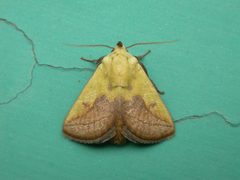
Monema is a of medium-sized yellowish in the Limacodidae, commonly known as slug moths or cup moths. The genus comprises at least four described distributed across East and Southeast Asia. Members are notable for their larval : caterpillars are flattened, legless in appearance, and move using suckers and liquefied silk lubricant in a wave-like motion resembling slugs. The genus includes significant forestry pests, particularly Monema flavescens, which has been introduced to North America.
Pronunciation
How to pronounce Monema: /məˈniːmə/
These audio files are automatically generated. While they are not always 100% accurate, they are a good starting point.
Identification
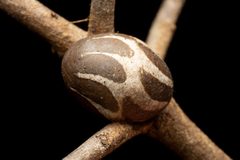
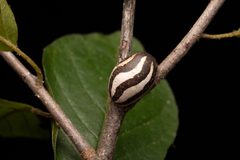
distinguished by medium size, yellowish coloration, and facial coloration patterns. Larvae identified by highly flattened body, sucker-based locomotion, and presence of urticating spines. Cocoons are hard-shelled and ovoid, located at twig-branch junctions. -level identification requires examination of genitalia and other detailed morphological features; M. flavescens, M. meyi, and other congeneric species have been historically confused and require careful differentiation.
Images
Habitat
Broadleaved forests and urban areas with trees. Larvae feed on foliage of various broadleaved trees and shrubs. Cocoons are attached to woody substrates at junctions between twigs and branches or directly on tree trunks.
Distribution
Nepal, Bhutan, China, Russian Far East, Korea, Japan, and northern Vietnam. The is native to East and Southeast Asian temperate and subtropical regions.
Seasonality
of emerge from late June to late August. One generation per year in temperate regions (e.g., Massachusetts, USA); two generations per year in warmer climates (e.g., Japan) with first generation adults in June and second in mid-to-late August.
Diet
Larvae are defoliators of broadleaved trees. Monema flavescens has been documented on 51 plant in 24 including Acer, Castanea, Quercus, Betula, Juglans, Malus, Prunus, Pyrus, Salix, Ulmus, Vaccinium, Diospyros, and Ziziphus.
Host Associations
- Acer palmatum - larval defoliation
- Acer platanoides - larval defoliation
- Acer pseudoplatanus - larval defoliation
- Betula lenta - larval defoliation
- Betula nigra - larval defoliation
- Castanea crenata - larval defoliation
- Castanea sativa - larval defoliation
- Diospyros kaki - larval defoliation
- Juglans regia - larval defoliation
- Malus spp. - larval defoliation
- Prunus spp. - larval defoliation
- Pyrus spp. - larval defoliation
- Quercus acutissima - larval defoliation
- Quercus serrata - larval defoliation
- Quercus variabilis - larval defoliation
- Salix chaenomeloides - larval defoliation
- Ulmus spp. - larval defoliation
- Ziziphus jujuba - larval defoliation
- Chrysis shanghalensis - larval ectoparasitoid of Monema flavescens
- Eurytoma monemae - potential agent
Life Cycle
Complete with four stages: , larva, pupa, . Eggs laid in groups on undersides of leaves; hatch in approximately one week. Larvae pass through 6-8 instars, feeding on foliage. Young larvae skeletonize leaf undersides; older larvae consume entire leaves except main . Fully grown larvae move to bark and construct hard, ovoid cocoons at twig-branch junctions or on trunks. occurs as fully grown larva or within the cocoon. in spring, with adult in summer. One or two per year depending on latitude and climate.
Behavior
are with limited capacity; short-distance only. Females exhibit age-dependent calling with distinct diel periodicity: one-day-old females begin calling 4 hours after scotophase onset, while 5-6 day old females call during the first hour of scotophase. Peak calling activity occurs at 2 days of age. Males become sexually responsive on the third night after . Mating is optimally achieved 4-6 hours after scotophase onset for 2-3 day old virgin females. Larval locomotion is distinctive: flattened body moved via suckers in wave-like motion, aided by liquefied silk secretion.
Ecological Role
Larvae function as defoliators of broadleaved trees, capable of influencing tree health and forest diversity. In native Asian range, natural enemies including (Chrysis shanghalensis, Eurytoma monemae) and other regulate , preventing major pest . The serves as for specialized parasitoids, contributing to complexity in broadleaved forest .
Human Relevance
Monema flavescens is a significant forestry and orchard pest in China, causing defoliation of economically important trees. The has been introduced to North America (Massachusetts, USA) where it represents an emerging threat. Caterpillars possess urticating spines that can cause skin irritation and health effects in humans. The has been evaluated for status in the European Union due to potential establishment risk and impacts on forest diversity. potential exists through natural enemies from native range.
Similar Taxa
- ParasaBoth are limacodid with slug-like larvae and urticating spines; distinguished by coloration patterns and larval
- CnidocampaMonema flavescens has been synonymized with or confused under Cnidocampa flavescens in some literature; taxonomic status requires verification
- Other Limacodidae generaShared characteristics of slug-like larvae and hard cocoons; Monema distinguished by yellowish coloration and specific larval associations
Misconceptions
Monema flavescens, M. meyi, and congeneric have been frequently misidentified due to similar , requiring revision of biological literature. Prior to taxonomic revision, M. meyi and newly described species were mistaken for M. flavescens, confounding studies of their respective and associations.
More Details
Taxonomic History
The was established by Walker in 1855. A 2013 revision of Chinese Monema documented 4 and 1 in China, including one newly described species. Species-level remains active with ongoing confusion between M. flavescens, M. meyi, and related requiring biological revision.
Biological Control
Natural enemies from native Asian range, including the chrysidid Chrysis shanghalensis and eurytomid wasp Eurytoma monemae, have been investigated for of . Effectiveness depends on establishment and impact of these in introduced ranges.
Research Needs
of larvae, definitive plant associations, and bionomics of M. meyi and other recently distinguished require study to separate from historical literature conflated under M. flavescens.
Sources and further reading
- BugGuide
- Wikipedia
- iNaturalist taxon
- NCBI Taxonomy
- Catalogue of Life
- Pensoft blog - Part 142
- Uncategorized | Blog - Part 36
- A new species of yellow slug moth from China | Blog
- Pest categorisation of Monema flavescens
- Daily rhythmicity in the sexual behaviour of Monema flavescens (Lepidoptera: Limacodidae)
- Antennal Sensilla of Chrysis shanghalensis (Hymenoptera: Chrysididae), a Larval Ectoparasite of Monema flavescens (Lepidoptera: Limacodidae)
- Is Eurytoma monemae RUSCHKA (Hymenoptera: Eurytomidae) an Effective Parasitoid for Control of Monema flavescens WALKER or Parasa sinica (MOORE) (Lepidoptera: Limacodidae)?
- Annual Change in Distribution and Rate of Parasitism of the Slug Moth, Monema flavescens WALKER, in Kanazawa City