
Parasa
Moore, 1860
slug moths
Species Guides
2- Parasa chloris(Smaller Parasa Moth)
- Parasa indetermina(stinging rose moth)
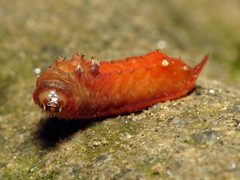
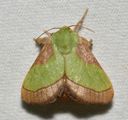
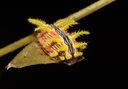
Parasa is a pantropical of slug moths ( Limacodidae) characterized by with green-banded forewings and larvae possessing stinging hairs. The genus was established by Frederic Moore in 1860 and contains numerous distributed across Asia, the Americas, and other tropical regions. Recent taxonomic revisions have clarified the identity of the type species P. chloris and used to resolve relationships among morphologically similar species. The genus includes both and herbivores, with at least one species documented as the first conifer-feeding specialist in the family.
Pronunciation
How to pronounce Parasa: /pəˈrɑːsə/
These audio files are automatically generated. While they are not always 100% accurate, they are a good starting point.
Identification
can be distinguished from similar Limacodidae by the combination of: palpi projecting beyond frontal tuft; forewings rounded at apex with 7, 8, 9 stalked; hindwing with veins 6 and 7 on short stalk or from ; and hind tibia with terminal pair of spurs. The green-banded forewing pattern is characteristic but not unique to the . -level identification requires examination of male genitalia and (COI), as morphologically similar species such as P. chloris and P. indetermina are sympatric and difficult to separate by wing pattern alone.
Images
Habitat
occur in diverse from lowland tropical forests to mid-elevation mountain regions. Some species inhabit restored prairie remnants and oak-hickory forests in North America. At least one species (P. indetermina) has been documented in calcareous fen habitats.
Distribution
Pantropical distribution. Documented from: North America (north-eastern and southern USA), Central America, South America, Asia (China, Taiwan, Japan, India, Southeast Asia), and other tropical regions. Specific type locality of P. chloris established as north-eastern USA, likely southern states, correcting earlier vague 'Amer. mer.' indications.
Host Associations
- Picea morrisonicola - larval First record of conifer-feeding in Limacodidae; herbivore in Taiwan (P. undulata group)
- Quercus stellata - larval P. indetermina larvae observed on post oak in Missouri prairie remnants
- Quercus marilandica - larval P. indetermina larvae observed on blackjack oak
- Myrica - larval P. indetermina larval feeding documented
Behavior
Larvae possess stinging hairs for defense. At least one shows background color matching with foliage, suggesting cryptic . activity patterns poorly documented; some species attracted to ultraviolet light.
Ecological Role
Herbivores, with some acting as feeders on conifers—a unique ecological role as the first documented conifer specialist in the . Larval stinging hairs suggest anti- defense function.
Human Relevance
P. lepida (blue-striped nettle , castor slug caterpillar) is a documented pest of multiple crops including coconut, oil palm, castor, coffee, cacao, mulberry, mango, pineapple, pomegranate, and tea in Asia. Larval stinging hairs can cause in humans upon contact.
Similar Taxa
Misconceptions
The type P. chloris was long confused with P. indetermina due to similar , despite differing larvae; resolved through and examination. Historical 'Amer. mer.' locality data for P. chloris incorrectly suggested South American origin rather than North America.
More Details
Taxonomic history
Type P. chloris (Herrich-Schäffer, 1854) had confused nomenclatural history with syntypes passing through multiple collections over ca. 180 years. Recent revision designated lectotype and established true type locality in north-eastern USA.
Phylogenetic research
COI barcoding has been employed to delimit boundaries and test monophyly of the , revealing cryptic diversity and supporting taxonomic revisions including P. huachuca stat. nov. and P. cuernavaca stat. rev.
Specialist feeding
The P. undulata group includes the first documented conifer-feeding in Limacodidae, with larvae feeding exclusively on Picea morrisonicola in Taiwan—representing both a -level behavioral novelty and the first specialist herbivore recorded in the .
Sources and further reading
- BugGuide
- Wikipedia
- GBIF taxonomy match
- iNaturalist taxon
- NCBI Taxonomy
- Catalogue of Life
- Megalopygidae | Beetles In The Bush
- Pensoft Editorial Team | Blog - Part 134
- Uncategorized | Blog - Part 30
- Newly-Discovered Bacterium Helps Honey Bee Larvae
- Parasa lepida . [Distribution map].
- On the identity of the type species of Parasa (Lepidoptera: Limacodidae): investigations into the Nearctic Parasa chloris and related taxa