
Euclea
Hübner, 1822
Euclea Slug Moths
Species Guides
4- Euclea delphinii(Spiny Oak-slug Moth)
- Euclea incisa(Green Oak-slug Moth)
- Euclea nanina(Nanina Oak-Slug Moth)
- Euclea obliqua
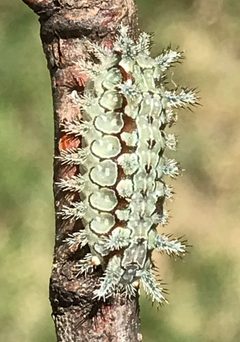
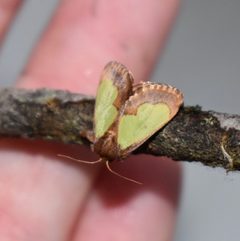
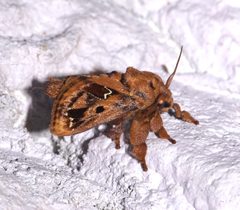
Euclea is a of slug caterpillar moths in the Limacodidae, containing at least 40 described . The genus was established by Hübner in 1822. Larvae are known for their distinctive flattened, slug-like form and possess venomous spines that can deliver painful stings. The genus is well-represented in North America with species such as Euclea delphinii (spiny oak slug ) and Euclea incisa (green oak-slug moth).
Pronunciation
How to pronounce Euclea: //ˈjuːkliːə//
These audio files are automatically generated. While they are not always 100% accurate, they are a good starting point.
Identification
Euclea larvae can be distinguished from other limacodid by their specific color patterns and associations. Euclea delphinii is recognized by its lichen-colored, spiny appearance on oak foliage. Euclea incisa is identified by its green coloration. Separation from similar slug genera such as Apoda and Parasa requires examination of larval coloration, body shape, and spination patterns.
Images
Habitat
occur in deciduous forest , particularly oak-hickory forests. Euclea delphinii has been documented in restored tallgrass prairie remnants with adjacent oak woodland. Larvae are found on foliage of trees including Quercus stellata (post oak), Quercus marilandica (blackjack oak), and other oak species.
Distribution
The occurs in North America. Specific documented locations include Missouri Ozarks (Washington County), Kansas (Leavenworth), and presumably throughout the eastern and central United States where suitable oak exists.
Seasonality
Larval activity has been observed in late summer (August) in Missouri. are attracted to ultraviolet light at night.
Diet
Larvae feed on oak foliage (Quercus spp.), including Quercus stellata and Quercus marilandica. feeding habits are not documented.
Host Associations
- Quercus stellata - larval post oak
- Quercus marilandica - larval blackjack oak
Life Cycle
Complete with , larval, pupal, and stages. Larvae progress through multiple instars, with early instars not described in available sources. likely occurs in a cocoon, as is typical for Limacodidae.
Behavior
Larvae are slow-moving and feed exposed on leaf surfaces. are and attracted to ultraviolet light sources.
Ecological Role
Larvae function as herbivores on oak trees, contributing to nutrient cycling through leaf consumption. Their stinging spines provide defense against vertebrate .
Human Relevance
Larvae can deliver painful stings through venomous spines, presenting a minor hazard to humans handling them. The is of interest to lepidopterists and naturalists.
Similar Taxa
- ApodaBoth are limacodid with slug-like larvae; Apoda y-inversa has a nearly amorphous, yellow-collared appearance distinct from Euclea
- ParasaBoth are limacodid with stinging larvae; Parasa indetermina (stinging rose slug ) has a more striking, contrasting color pattern
- MegalopygeBoth are zygaenoid with venomous larval setae; Megalopyge larvae are covered in dense flannel-like hair rather than flattened and slug-like
More Details
Taxonomic note
The name Euclea has been used for both this (Hübner, 1822) and a genus of flowering plants in the ebony (Linnaeus, 1774). These are homonyms representing entirely unrelated organisms.
Venomous larvae
All Limacodidae larvae possess venomous spines, and Euclea are no exception. The sting can cause localized pain, redness, and swelling in humans.