
Euclea delphinii
(Boisduval, 1832)
Spiny Oak-slug Moth, Spiny Oak Slug
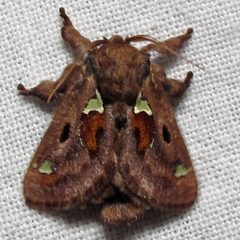
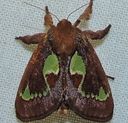
Euclea delphinii, commonly known as the spiny oak-slug , is a of slug caterpillar moth in the Limacodidae. The caterpillars are notable for their distinctive appearance and venomous spines. are relatively nondescript moths. The species has been documented across much of eastern North America, with larvae feeding on various oak species.
Pronunciation
How to pronounce Euclea delphinii: /juːˈkleɪə dɛlˈfɪnaɪ.aɪ/
These audio files are automatically generated. While they are not always 100% accurate, they are a good starting point.
Identification
Larvae are distinguished from other Limacodidae by their lichen-like coloration and specific arrangement of spines. They may be confused with other slug caterpillars such as Apoda y-inversa (yellow-collared slug moth) or Parasa indetermina (stinging rose slug moth), but differ in coloration and association. Euclea delphinii is specifically associated with oak foliage (Quercus spp.), whereas related may occur on different host plants. The lichen-colored appearance helps distinguish it from the more vividly colored Parasa indetermina or the nearly amorphous Apoda y-inversa.
Images
Habitat
Deciduous forests and woodlands, particularly areas with oak trees. Documented in restored tallgrass prairie remnants with adjacent oak-hickory forest. Occurs in both upland and dry-mesic forest conditions.
Distribution
Eastern North America. Documented from Vermont southward through the eastern United States. Specific records include southwestern Washington County, Missouri, and Vermont.
Seasonality
active during summer months. Larvae observed in late summer (August-September). One observation records caterpillars found in late August.
Diet
Larvae feed on foliage of oak (Quercus spp.), specifically documented on Quercus stellata (post oak).
Host Associations
- Quercus stellata - larval food plantPost oak
Life Cycle
Complete with , larva, pupa, and stages. Larval stage is the most commonly observed and distinctive phase. likely occurs in leaf litter or soil.
Behavior
Larvae are slow-moving and feed exposed on leaf surfaces. When disturbed, they may curl into a defensive posture. The venomous spines serve as a defense against .
Ecological Role
Herbivore in oak woodland . Larvae consume oak foliage, contributing to nutrient cycling. Serves as prey for various including birds and , though venomous spines provide some protection.
Human Relevance
Caterpillars can deliver a painful sting through their venomous spines, making them a minor medical concern. They are not considered significant agricultural pests. Of interest to entomologists and naturalists for their distinctive appearance.
Similar Taxa
- Apoda y-inversaBoth are Limacodidae slug caterpillars with stinging spines, but A. y-inversa has a nearly amorphous, yellow-collared appearance rather than lichen-like coloration.
- Parasa indeterminaBoth are stinging slug caterpillars, but P. indetermina is more vividly colored with green and red markings and typically found on rose plants rather than oaks.
More Details
Venomous spines
Like all Limacodidae caterpillars, E. delphinii possesses venomous spines (urticating setae) that can cause painful reactions upon contact with skin. This is a -wide trait, not unique to this .
Field observation note
In a 2024 field observation in Missouri, caterpillars were found on post oak foliage near ultraviolet light stations, suggesting possible activity or patterns.