
Ypsolopha dentella
(Fabricius, 1775)
Honeysuckle Moth
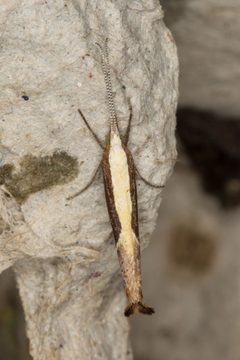
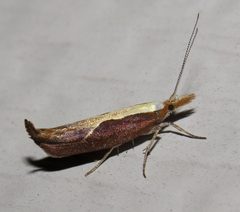
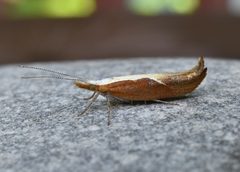
Ypsolopha dentella, commonly known as the honeysuckle , is a small moth in the Ypsolophidae. have a wingspan of 18–23 mm and exhibit distinctive wing patterns with a strongly falcate (hooked) apex. The is notable for its unusual resting posture, with adults hanging upside down and stretched forward. Larvae feed within silken webs on plants and construct cocoon-like pupal cradles attached to vegetation.
Pronunciation
How to pronounce Ypsolopha dentella: /ɪpˈsɒləfə dɛnˈtɛlə/
These audio files are automatically generated. While they are not always 100% accurate, they are a good starting point.
Identification
Distinguished from similar Ypsolopha by the combination of: strongly falcate forewing apex; deep ochreous-brown forewing coloration with light yellow streak and fine white edging line; white and contrasting with deep brown . The characteristic upside-down resting posture with stretched forward is typical of Ypsolophidae but not unique to this species. Larvae identified by pale yellowish-green color with broad brown-reddish dorsal stripe and web-forming on honeysuckle and related .
Images
Habitat
Associated with supporting plants Lonicera (honeysuckle), Symphoricarpos albus (snowberry), and Weigela. Larvae occur on leaves, buds, and twigs where they construct feeding webs.
Distribution
Europe, Anatolia, north-eastern China, Russia, mideast Asia, eastern United States, and southern Canada.
Seasonality
fly from June to September, with timing varying by location.
Diet
Larvae feed on honeysuckle (Lonicera), Symphoricarpos albus, and Weigela. do not feed; mouthparts reduced or non-functional.
Host Associations
- Lonicera - larval food plantHoneysuckle
- Symphoricarpos albus - larval food plantSnowberry
- Weigela - larval food plant
Life Cycle
laid on plant. Larva hatches and lives solitarily in silken web on leaves, buds, or twigs, feeding on host tissue. When mature, larva constructs cocoon-like cradle attached to host plant and pupates within. emerges and flies during summer months.
Behavior
rest upside down with stretched forward, a characteristic posture of Ypsolophidae. Adults fly infrequently to light compared to many . Larvae live solitarily within silken webs on plants.
Ecological Role
Herbivore as larva; contributes to nutrient cycling through leaf herbivory. Serves as prey for and other natural enemies.
Human Relevance
Minor potential as garden pest on ornamental honeysuckle and Weigela. Scientific interest due to unusual resting posture and difficulty of collection. No significant economic impact documented.
Similar Taxa
- Other Ypsolopha speciesShare characteristics including falcate forewing apex and upside-down resting posture; distinguished by specific wing pattern elements (coloration, streak patterns, and line details)
More Details
Collection difficulty
Ypsolophid are notoriously difficult to collect using standard methods. Breeding from larvae and light trapping both work rarely for this group, making specimen acquisition notable for entomologists.
Sources and further reading
- BugGuide
- Wikipedia
- GBIF taxonomy match
- iNaturalist taxon
- NCBI Taxonomy
- Uncategorized | Blog - Part 38
- Pensoft Editorial Team | Blog - Part 143
- Catch me if you can: 2 new species of moth from the Russian Far East | Blog
- <p class="HeadingRunIn" align="left">Review of the genus Ypsolopha Latreille, 1796 from China (Lepidoptera: Ypsolophidae)