
Ypsolophidae
Guenée, 1845
Genus Guides
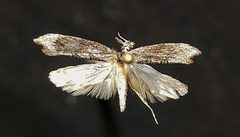
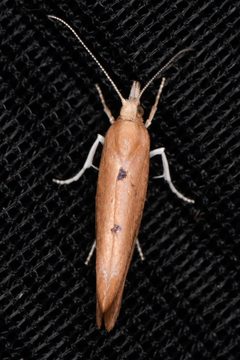
2Ypsolophidae is a of small comprising approximately 160 described . are characterized by a distinctive resting posture: hanging upside down with stretched forward. The family is sometimes treated as a of Plutellidae by some authors. Species occur primarily in the Holarctic region, with highest diversity in East Asia and Europe, though some species extend into the Neotropics.
Pronunciation
How to pronounce Ypsolophidae: //ɪpsoʊˈlɒfɪdi//
These audio files are automatically generated. While they are not always 100% accurate, they are a good starting point.
Identification
Ypsolophidae are small , typically 6–13 mm in length, with forward-projecting that are often banded. The characteristic resting posture—hanging upside down with antennae extended forward—is a key field mark. Larvae construct loose silk webs on plant foliage, buds, and twigs. occurs within a cocoon-like cradle attached to the host plant.
Images
Habitat
Ypsolophidae occupy diverse environments including forests, shrublands, and arid steppes. Specific documented include: oak forests in Turkey; clay-steppes of European Russia; arid highlands of the western Andes slopes; mixed conifer-oak forests at 7,000 feet elevation in the southwestern United States; and coastal areas of southwest Portugal.
Distribution
Widespread distribution with centers of diversity in the Northern Hemisphere. Documented from: Europe (including Portugal, Italy, Russia); East Asia (China, Japan, Korea, Russian Far East); Turkey; North America; and the Andes of northern Chile. The Russian Far East alone harbors approximately 30 , representing one-quarter of global diversity.
Diet
Larvae are herbivorous, feeding within silk webs on leaves, buds, and twigs of plants. Documented host plant include: Rosaceae (Crataegus, Pyrus), Aceraceae (Acer), Pinaceae (Pinus), Ephedraceae (Ephedra), Polygonaceae (Muehlenbeckia), and Fabaceae (Adesmia).
Life Cycle
Complete with documented pupal duration averaging 18 days in Ypsolopha ustella. Larvae typically live solitary on plants. occurs in a cocoon-like cradle attached to the host plant.
Behavior
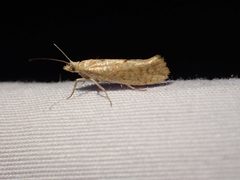
exhibit a distinctive resting posture, hanging upside down with stretched forward. Adults of many are infrequently attracted to light, making collection difficult. Standard collecting methods—breeding from larvae or light trapping—are often ineffective.
Human Relevance
Some are of interest to entomologists due to their unusual and , though the has limited direct economic importance. The difficulty of collecting specimens makes new species discoveries notable events in lepidopterology.
Similar Taxa
- PlutellidaeYpsolophidae is sometimes included within Plutellidae by many authors; the two share small size and similar larval habits, though Ypsolophidae is distinguished by its characteristic upside-down resting posture with forward-extended
- GelechiidaeBoth contain small with banded ; Ypsolophidae differs in resting posture and larval web construction
Sources and further reading
- BugGuide
- Wikipedia
- GBIF taxonomy match
- iNaturalist taxon
- NCBI Taxonomy
- Catalogue of Life
- Bug Eric: New Mexico Night Bugs
- Uncategorized | Blog - Part 38
- Pensoft Editorial Team | Blog - Part 143
- Catch me if you can: 2 new species of moth from the Russian Far East | Blog
- Five new East-Asian species of the genus Ypsolopha Latreille (Lepidoptera: Ypsolophidae)
- Ypsolopha milfontensis Corley & Ferreira, a new species from the Portuguese coast (Lepidoptera: Ypsolophidae)
- Ypsolopha admirandella sp. n. (Lepidoptera: Ypsolophidae), a new European species from the steppes of Russia
- <p class="HeadingRunIn" align="left">Review of the genus Ypsolopha Latreille, 1796 from China (Lepidoptera: Ypsolophidae)
- On Ypsolopha micromoths (Lepidoptera, Ypsolophidae) associated with Adesmia shrubs (Fabaceae) in the arid western slope of the central Andes
- Ypsolopha chicoi sp. n., the second representative of the widespread micromoth genus Ypsolopha Latreille (Lepidoptera, Ypsolophidae) from the Andes of northern Chile
- Figure 7 from: Vargas HA (2024) On Ypsolopha micromoths (Lepidoptera, Ypsolophidae) associated with Adesmia shrubs (Fabaceae) in the arid western slope of the central Andes. ZooKeys 1195: 131-138. https://doi.org/10.3897/zookeys.1195.116134
- Contribution to the knowledge of Ypsolophidae from forested habitats of Southern Italy with an update of the Italian checklist of the genus Ypsolopha Latreille 1796 (Lepidoptera: Yponomeutoidea)
- Wing color and pattern variations in the Turkish population of Ypsolopha ustella (Clerck, 1759) on oak and some additional notes (Lepidoptera, Ypsolophidae)
- Figures 5- 6 from: Vargas HA (2024) On Ypsolopha micromoths (Lepidoptera, Ypsolophidae) associated with Adesmia shrubs (Fabaceae) in the arid western slope of the central Andes. ZooKeys 1195: 131-138. https://doi.org/10.3897/zookeys.1195.116134
- Figures 1-4 from: Vargas HA (2024) On Ypsolopha micromoths (Lepidoptera, Ypsolophidae) associated with Adesmia shrubs (Fabaceae) in the arid western slope of the central Andes. ZooKeys 1195: 131-138. https://doi.org/10.3897/zookeys.1195.116134