
Ypsolopha cockerella
Ypsolopha cockerella is a in the Ypsolophidae, known from the United States including New Mexico. The has a wingspan of approximately 19–21 mm. exhibit the characteristic resting posture of Ypsolophid moths, hanging upside down with stretched forward. The species was originally described under the Abebaea.
Pronunciation
How to pronounce Ypsolopha cockerella: /ɪpˈsɒlɔfə kɒkəˈrɛlə/
These audio files are automatically generated. While they are not always 100% accurate, they are a good starting point.
Identification
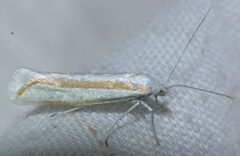
Distinguished from similar Ypsolopha by the combination of silvery white forewings with two distinct golden brown streaks—one broad streak along the fold from base to tornus, and a narrower subcostal streak. The white with dark fuscous spots and the white labial palpi with elongated tuft are additional diagnostic features. The light golden brown shoulder coloration and brown-touched edge further aid identification.
Images
Appearance
Wingspan 19–21 mm. white, each joint with a dark fuscous spot in front. Labial palpi white; tuft on second joint longer than short terminal joint. , and white with slight yellowish tint; shoulders very light golden brown. Forewings shining silvery white with broad very light golden brown streak running from base to tornus along and crossing the fold; narrower similar golden streak just below costal edge. edge touched with brown. Hindwings light silvery fuscous. Legs and underside of body white.
Distribution
United States, including New Mexico
Behavior
rest in the characteristic Ypsolophid posture: hanging upside down with stretched forward. Adults fly to light infrequently, making collection difficult.
Similar Taxa
- Other Ypsolopha speciesSimilar resting posture and general body plan; distinguished by specific wing pattern of golden brown streaks on silvery white background
More Details
Taxonomic history
Originally described as Abebaea cockerella before transfer to Ypsolopha
Collection difficulty
Like other Ypsolophids, fly to light infrequently and larvae are solitary and hard to find, making this difficult to collect