
Plutella porrectella
Linnaeus, 1758
Dame's Rocket Moth
Plutella porrectella is a small plutellid closely related to the (P. xylostella). Unlike its relative, this has a restricted Palearctic distribution and specialized tied to dame's rocket (Hesperis matronalis). It completes two annually and overwinters as a first-instar larva concealed within plant buds. The species appears to offer limited value as an alternative host for agents targeting the diamondback moth.
Pronunciation
How to pronounce Plutella porrectella: /pluˈtɛl.la pɔˌrɛkˈtɛl.la/
These audio files are automatically generated. While they are not always 100% accurate, they are a good starting point.
Identification
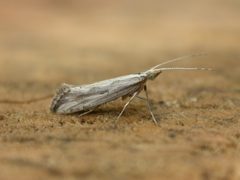
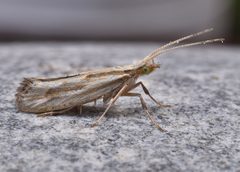
Distinguished from the (P. xylostella) by forewing pattern: P. porrectella shows a whitish line with three upward sinuations and ochreous-brown termen with black spots, whereas P. xylostella has characteristic diamond-shaped markings along the forewing margin. P. porrectella also differs biologically in having only two per year versus multiple generations in P. xylostella, and in as larvae within buds rather than as . The long palpi tuft is also distinctive.
Images
Appearance
Small with wingspan 14–17 mm. ochreous-whitish with central fuscous line. Palpi with long tuft. Forewings pale ochreous with whitish suffused streaking; and dorsum with blackish dots; distinct whitish longitudinal line with three upward sinuations, margined above by ochreous-brownish suffusion and blackish darkest in depressions; discal stigmata indicated by dark fuscous dashes; termen ochreous-brown with black spots. Hindwings light grey. Larva light green with darker line, black dots, and brownish-marked head.
Habitat
Associated with dame's rocket (Hesperis matronalis); larvae develop within buds of plants. Specific requirements beyond host association are not documented.
Distribution
Europe, Caucasus, southern Siberia, and Asia Minor. GBIF records confirm presence in Belgium.
Seasonality
active in May and again from July to August. with two per year.
Diet
Larvae feed on Brassicaceae, specifically Hesperis matronalis (dame's rocket). They distort or connect leaves with small amounts of silk.
Host Associations
- Hesperis matronalis - primary Larvae feed on leaves and develop within buds; occurs inside buds
Life Cycle
(two per year). Overwinters as first-instar larva concealed within buds of Hesperis matronalis. Laboratory rearing at 25°C showed four larval instars with mean generation time of 30 days. and details not explicitly documented.
Behavior
Larvae use silk to distort or connect plant leaves. larvae remain concealed within buds of host plant.
Ecological Role
Herbivore specialized on Hesperis matronalis. Poor alternative for of : only Itoplectis conquisitor was reared from 228 field-collected larvae, suggesting limited value in programs.
Human Relevance
Minor or negligible economic impact; not a significant agricultural pest like the related . Potential interest for understanding Plutella and comparative studies with P. xylostella.
Similar Taxa
- Plutella xylostella with similar size and general appearance; distinguished by diamond-shaped forewing markings, multiple , and broad range on cruciferous crops
More Details
Parasitism and biological control
A study of 228 field-collected larvae yielded only one (Itoplectis conquisitor), indicating P. porrectella is not a useful for natural enemies of the
Taxonomic history
Originally described as Phalaena porrectella by Linnaeus in 1758
Sources and further reading
- BugGuide
- Wikipedia
- GBIF taxonomy match
- iNaturalist taxon
- NCBI Taxonomy
- Catalogue of Life
- How Many Species of Moths at Bohart Museum's Moth Night? | Bug Squad
- Beneficial Insects and Nematodes are not Harmed by Genetically-modified, Insect-resistant Plants
- How One Entomologist Puts a Childhood Love of Insects to Work in IPM
- A New Pesticide-Free Way to Control Diamondback Moths
- Uncategorized | Blog - Part 33
- Assay Array: Entomologists' Lab Tests Expose Insect Secrets
- LIFE HISTORY OF PLUTELLA PORRECTELLA, A RELATIVE OF THE DIAMONDBACK MOTH, PLUTELLA XYLOSTELLA (LEPIDOPTERA: PLUTELLIDAE)