
Leucoptera spartifoliella
(Hübner, 1813)
Scotch broom twig miner, broom twig miner
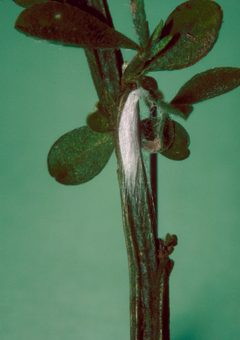
A tiny white microlepidopteran , approximately 4 mm in length, used as a agent against the weed Scotch broom (Cytisus scoparius). Native to western and central Europe, it has been introduced to New Zealand (accidentally, 1950s), California (1960), and Australia (1990) to manage broom . The female has been identified as 5-methylheptadecane, enabling monitoring through trapping.
Pronunciation
How to pronounce Leucoptera spartifoliella: /ˌluːkɒpˈtɛrə ˌspɑːrtɪfəˈliːɛlə/
These audio files are automatically generated. While they are not always 100% accurate, they are a good starting point.
Identification
Distinguished from Leucoptera laburnella by forewing pattern: anteapical spot of more oblique with converging margins, and metallic post-tornal spot more broadly black-edged, usually with preceding yellowish mark. Extremely small size (3–4 mm) and white coloration characteristic of .
Images
Appearance
are tiny white approximately 3–4 mm long. Forewings display an oblique anteapical spot on the with margins converging downward; metallic post-tornal spot broadly edged with black and usually preceded by a yellowish mark. Distinguished from the similar Leucoptera laburnella by these wing pattern characteristics.
Habitat
Temperate regions where plant Cytisus scoparius occurs; established in Scotch broom plantations and naturalized broom stands. Requires young stem tissue for larval development.
Distribution
Native to western and central Europe (including Belgium). Introduced to New Zealand (1950s, accidental establishment), California USA (early 1960s), and Australia (1990). Now present in parts of western United States, Australia, and both North and South Islands of New Zealand.
Seasonality
emerge under 16:8 light:dark at 23°C. Pupae collected from stems during spring and summer (October/November in Southern Hemisphere). Females call during first 2 hours of scotophase.
Diet
Larvae feed exclusively on stem tissues of Cytisus scoparius (Scotch broom) and Cytisus purgans (Spanish gold broom). do not feed.
Host Associations
- Cytisus scoparius - obligate larval Scotch broom; primary target for
- Cytisus purgans - larval Spanish gold broom
Life Cycle
Female lays singly on Scotch broom stems. Larva mines within stem for nearly one year before pupating in silk cocoon on stem. Pupae recovered during spring and summer; emerge under controlled conditions (16:8 L:D, 23°C). Virgin females begin calling at 2–3 days old.
Behavior
Females exhibit calling during first 2 hours of scotophase (dark period), releasing to attract males. Males attracted to synthetic 5-methylheptadecane in dose-dependent manner (1 mg dose most effective in field trials).
Ecological Role
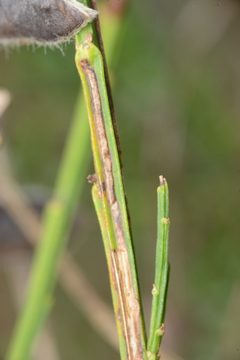
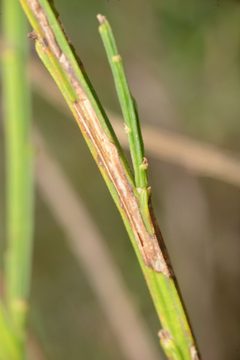
Specialized herbivore and agent for Scotch broom. Larval stem mining reduces plant growth and longevity; severe can cause plant death, often mediated by secondary following insect damage.
Human Relevance
Deployed as agent for Cytisus scoparius in USA, Australia, and New Zealand. -based monitoring tools developed using 5-methylheptadecane to assess , distribution, and . Effectiveness variable: plants often recover from damage, with mortality primarily occurring when damage predisposes plants to .
Similar Taxa
- Leucoptera laburnellaSimilar size and appearance; distinguished by less oblique anteapical spot, non-converging margins, and narrower black edging on post-tornal spot without preceding yellowish mark
More Details
Pheromone identification
identified as 5-methylheptadecane through GC/MS/CI analysis and synthesis confirmation. Field trials showed cotton ball in glass vial superior to rubber septum as release substrate.
Biocontrol efficacy
Considerable damage to plants documented, but recovery common. Plant mortality primarily results from secondary following insect damage rather than direct killing. Research shifted toward additional biocontrol agents for integrated management.