
Glyphipteriginae
Stainton, 1854
Sedge Moths
Genus Guides
5- Abrenthia
- Diploschizia(sedge moths)
- Drymoana
- Glyphipterix(sedge moths)
- Lepidotarphius
Glyphipteriginae is a of small within the Glyphipterigidae, commonly known as sedge moths. The group is characterized by metallic coloration and distinctive wing patterns. Larval stages are associated with sedges (Cyperaceae) and rushes (Juncaceae), with some mining leaves or stems of these plants. The subfamily has a distribution with highest diversity in temperate regions.

Pronunciation
How to pronounce Glyphipteriginae: /ɡlɪfɪptəˈrɪdʒɪniː/
These audio files are automatically generated. While they are not always 100% accurate, they are a good starting point.
Identification
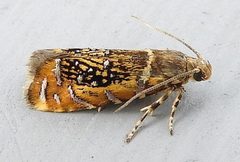
are small , usually 6–12 mm in wingspan, with narrow, forewings that often display metallic bronze, , or golden iridescence. Many have distinctive pale or silvery markings on the forewings, including transverse bands or spots. The hindwings are narrower and more pointed than the forewings, with reduced venation. are and approximately two-thirds the length of the forewing. At rest, wings are held tightly roof-like over the body, giving a slender, cylindrical profile.
Images
Habitat
Associated with wetland and marshy environments where plants of the Cyperaceae and Juncaceae occur. include fens, bogs, wet meadows, lake margins, and riverbanks. Some occupy drier grasslands where sedges persist. Larval stages are confined to living host plants.
Distribution
distribution with greatest in the Palearctic and Nearctic regions. Present across Europe, Asia, North America, and Australia; records also from Africa and South America. Individual often have restricted ranges tied to specific plant distributions.
Seasonality
activity generally occurs during late spring through summer in temperate regions, with peak periods varying by latitude. Some are with a single , while others may have partial second generations in favorable climates. Larval feeding occurs primarily during summer months.
Diet
Larvae feed on Cyperaceae (sedges) and Juncaceae (rushes). Feeding modes include leaf mining, stem boring, or feeding within seed . Specific associations are documented for some but remain unknown for many. do not feed; they possess non-functional mouthparts or reduced .
Host Associations
- Cyperaceae - larval plantPrimary ; larvae mine leaves, bore stems, or feed in seed
- Juncaceae - larval plantSecondary ; larval feeding documented in several
Life Cycle
Complete with four stages: , larva, pupa, . Eggs are deposited on plant tissues. Larvae are internal feeders, developing within plant tissues for several weeks. occurs within the larval feeding gallery or in a silken cocoon among host plant debris. stage varies by ; some overwinter as larvae within host stems, others as pupae. Adult lifespan is brief, typically 1–2 weeks.
Behavior
are or , often active in sunshine when they may be observed flying rapidly among plants with a darting, erratic pattern. They frequently rest on sedge stems with wings pressed flat, where metallic coloration provides camouflage. Larvae are concealed feeders, producing visible mines or causing stem discoloration. Some exhibit strong fidelity to specific host plant patches.
Ecological Role
Larvae function as herbivores on wetland monocots, with minimal impact on plant due to low densities. Serve as prey for including birds, spiders, and . Contribute to nutrient cycling in wetland through herbivory and subsequent decomposition of larval .
Human Relevance
No significant economic importance. Occasionally encountered by wetland ecologists and botanists. Some serve as indicators of healthy sedge-dominated wetland . are occasionally attracted to light traps.
Similar Taxa
- YponomeutinaeSimilar small size and narrow wings, but Yponomeutinae lack metallic coloration, have broader forewings with more rounded apices, and larvae are external leaf feeders on diverse woody plants rather than internal feeders on sedges.
- PlutellidaeOverlapping size range and some metallic , but Plutellidae have more triangular forewings with distinct venation patterns and larvae feed on Brassicaceae and other herbaceous plants, not sedges.