
Glyphipterix
Hübner, 1825
sedge moths
Species Guides
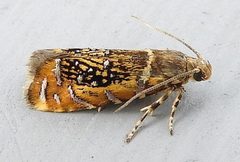
10Glyphipterix is a of sedge moths in the Glyphipterigidae, established by Jacob Hübner in 1825. The genus contains numerous small distributed across multiple continents. Biological details are documented for only a few species; the most thoroughly studied, G. loricatella, develops as a borer in Iris plants. The genus was formerly associated with sedges (Cyperaceae), but recent research has revealed broader plant associations including Iridaceae.

Pronunciation
How to pronounce Glyphipterix: /ɡlɪˈfɪptərɪks/
These audio files are automatically generated. While they are not always 100% accurate, they are a good starting point.
Images
Habitat
Associated with herbaceous plants; larvae develop in leaves and rhizomes of plants. For G. loricatella: leaves and rhizomes of Iris plants, with occurring in soil.
Distribution
Recorded from Europe (Denmark, Norway, Sweden, Hungary), North America (Vermont, United States), and other regions including Australia and Thailand. Distribution varies by .
Diet
Larvae of G. loricatella feed on Iris × germanica leaves and rhizome tissue. plant associations for most other in the remain undocumented.
Life Cycle
For G. loricatella: larvae develop over one year, initially in leaves then in rhizomes; overwinter as mature larvae in rhizome; exit rhizome in spring; pupate in soil cocoon covered with soil particles; pupal stage lasts 30–35 days. details for other are unknown.
Behavior
Larvae of G. loricatella push excrements out of rhizome, create leaf mines, and pupate in soil cocoons covered with soil particles. Females release for mating.
Ecological Role
Herbivore and borer in herbaceous plants; specific roles documented only for G. loricatella as a borer in ornamental Iris.
Human Relevance
G. loricatella has been observed in ornamental Iris plantings. Most have no documented economic or cultural significance.
Similar Taxa
- GlyphipteryxFormerly considered a separate ; treated by ICZN in 1986 as an unjustified emendation of Glyphipterix Hübner, [1825]
More Details
Taxonomic Note
The International Commission on Zoological ruled in 1986 that Glyphipteryx Curtis, 1827 is an unjustified emendation of Glyphipterix Hübner, [1825].
Host Plant Research
Iridaceae was documented as a new hostplant for the Glyphipterix based on rearing G. loricatella from Iris × germanica in Hungary (Takács & Szabóky, 2018). This finding expanded the known range beyond previously recorded associations.
Sources and further reading
- BugGuide
- Wikipedia
- GBIF taxonomy match
- iNaturalist taxon
- NCBI Taxonomy
- Catalogue of Life
- Discovery of the biology of Glyphipterix loricatella (Treitschke, 1833) (Lepidoptera, Glyphipterigidae), a borer in Iris (Iridaceae)
- Figures 7-10 from: Takács A, Szabóky C (2018) Discovery of the biology of Glyphipterix loricatella (Treitschke, 1833) (Lepidoptera, Glyphipterigidae), a borer in Iris (Iridaceae). Nota Lepidopterologica 41(1): 181-187. https://doi.org/10.3897/nl.41.24892
- Figures 1-6 from: Takács A, Szabóky C (2018) Discovery of the biology of Glyphipterix loricatella (Treitschke, 1833) (Lepidoptera, Glyphipterigidae), a borer in Iris (Iridaceae). Nota Lepidopterologica 41(1): 181-187. https://doi.org/10.3897/nl.41.24892