
Acleris
Hübner, [1825]
Species Guides
59- Acleris aenigmana
- Acleris albicomana(Red-edged Acleris Moth)
- Acleris albinivia
- Acleris arcticana
- Acleris bowmanana
- Acleris braunana(Alder Leafroller)
- Acleris britannia(Britannia moth)
- Acleris busckana
- Acleris caliginosana
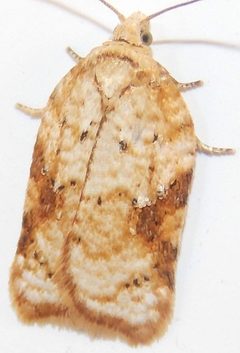
Acleris is a large of tortrix moths in the Tortricidae, containing approximately 241 as of 2007. The genus includes several economically significant forest pests, notably the black-headed budworm complex (A. gloverana-variana), which causes periodic in North American coniferous forests. Some species are also agricultural pests, such as A. comariana on strawberries. The genus has a Holarctic distribution with records from North America, Europe, and Asia.


Pronunciation
How to pronounce Acleris: //əˈklɛrɪs//
These audio files are automatically generated. While they are not always 100% accurate, they are a good starting point.
Images
Habitat
Coniferous forests for forest-dwelling such as A. gloverana and A. variana; agricultural and horticultural environments for pest species such as A. comariana.
Distribution
Holarctic distribution including North America (Canada and northern United States), Europe (Denmark, Norway, Sweden), and Asia. Specific distributions vary: A. gloverana occurs from Alaska and western Canada to California, Colorado, and Wyoming; A. variana ranges across eastern and central Canada to the northeastern United States.
Diet
Larval feeding habits vary by . A. gloverana and A. variana larvae feed on conifers including Abies, Larix, Picea, Pseudotsuga, and Tsuga, with geographic variation in preference. A. comariana feeds on strawberry (Fragaria).
Host Associations
- Abies - larval preferred in eastern areas for A. gloverana-variana complex
- Larix - larval
- Picea - larval most often utilized in southern Ontario for A. gloverana-variana complex
- Pseudotsuga - larval
- Tsuga - larval Tsuga heterophylla preferred in coastal British Columbia for A. gloverana-variana complex
- Fragaria - larval of A. comariana
Behavior
Some exhibit dynamics with occasional explosions causing extensive defoliation. has been investigated as a management strategy for A. comariana.
Ecological Role
Defoliator of coniferous forests; resident with periodic phases that significantly impact forest health. Some species function as agricultural pests.
Human Relevance
Several are economically significant pests. The black-headed budworm complex (A. gloverana-variana) is a serious and recurrent defoliator of coniferous forests in British Columbia, Washington, and other regions, causing timber losses and forest management challenges. A. comariana is a pest of strawberry crops. trials have been conducted for A. comariana management.
More Details
Species diversity
As of 2007, approximately 241 were recognized in the , making it one of the larger genera in Tortricidae.
Genomic resources
sequences have been published for Acleris ferrugana (Tawny Oak Tortrix) and Acleris laterana (Dark-triangle Button ).
Sources and further reading
- BugGuide
- Wikipedia
- GBIF taxonomy match
- iNaturalist taxon
- NCBI Taxonomy
- Catalogue of Life
- Acleris gloverana . [Distribution map].
- Acleris variana . [Distribution map].
- Taxonomic Studies on the Acleris gloverana-variana Complex, the Black-headed Budworms (Lepidoptera: Tortricidae)
- The genome sequence of the Tawny Oak Tortrix, Acleris ferrugana (Denis & Schiffermüller), 1775 (Lepidoptera: Tortricidae).
- The genome sequence of the Dark-triangle Button moth, Acleris laterana (Fabricius, 1794).
- Induced allopatry as main mechanism explaining trap catch reduction in low dose mating disruption trials on the strawberry pest Acleris comariana (Lepidoptera: Tortricidae).