
Aphelia alleniana
(Fernald, 1882)
wide-striped leafroller, Allen's tortrix moth
Aphelia alleniana is a tortricid native to northern North America, ranging from Alaska across Canada to parts of the western and northeastern United States. are active in late June to mid-July, with larvae feeding on herbaceous and woody plants while constructing characteristic leaf-roll shelters. The overwinters as a third-instar larva and completes a single per year.
Pronunciation
How to pronounce Aphelia alleniana: /əˈfiːliə əˌlɛniˈɑːnə/
These audio files are automatically generated. While they are not always 100% accurate, they are a good starting point.
Identification
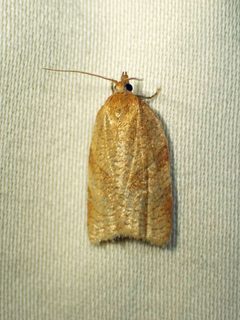
Distinguished from similar tortricids by the combination of light brown forewings with fine darker reticulations, the specific wingspan range of 21–27 mm, and its northern North American distribution. The "wide-striped leafroller" refers to the larval dark stripe, though this feature is shared with other leafroller larvae and is not diagnostic for the itself.
Images
Distribution
Native to northern North America. Recorded throughout Canada including Alberta, Manitoba, and Saskatchewan; extends north to Alaska. In the United States, documented from Colorado, Idaho, Maine, Montana, and Vermont.
Seasonality
active from late June to mid-July. , with one per year.
Diet
Larvae feed on herbaceous plants, with additional feeding observed on deciduous and coniferous woody plants.
Host Associations
- herbaceous plants - larval food plantprimary
- deciduous woody plants - larval food plantsecondary
- coniferous woody plants - larval food plantsecondary
Life Cycle
. laid in summer; larvae develop through five instars, as third instars within folded leaves. Overwintering larvae resume feeding in spring, then pupate within their larval shelter. emerge in late June to mid-July.
Behavior
Larvae construct leaf rolls using silk to tie or roll leaves together, creating shelters for feeding and protection from and weather. occurs within the larval shelter.
Ecological Role
Larval leaf-rolling creates microhabitats that may be used by other small arthropods; larvae function as herbivores in forest and meadow .
Human Relevance
No documented economic or agricultural significance. Occasionally encountered by naturalists and enthusiasts.
Similar Taxa
- Other Aphelia speciesAphelia is predominantly Palearctic; A. alleniana is one of few Nearctic representatives, distinguished by distribution and male genitalia.
- Other Tortricinae leafrollersShare leaf-rolling larval and general ; identification requires examination of genitalia or larval and geographic data.
More Details
Subspecies
Two recognized: A. a. alleniana (Fernald, 1882) and A. a. rindgeorum Obraztsov, 1959.
Taxonomic history
Originally described as Tortrix alleniana by Charles Henry Fernald in 1882; later transferred to Aphelia, which was established by Jacob Hübner in 1825.