
Taniva albolineana
(Kearfott, 1907)
Spruce Needleminer Moth
Taniva albolineana is a tortricid to North America, commonly known as the spruce needleminer moth. The is specialized on spruce (Picea spp.) as its plant, with larvae mining within needles. It is the sole member of the Taniva. The moth is primarily documented from the Canadian prairie provinces and adjacent regions.
Pronunciation
How to pronounce Taniva albolineana: /ˈtænɪvə ælboʊlaɪniˈænə/
These audio files are automatically generated. While they are not always 100% accurate, they are a good starting point.
Identification
Distinguished from other small tortricid moths by association with spruce and the distinctive needle-mining damage caused by larvae. identification requires examination of genitalia or close comparison with related Olethreutinae; specific wing pattern characters are not well documented in available sources.
Images
Habitat
Coniferous forests and plantations dominated by spruce (Picea). Associated with white spruce, black spruce, and Engelmann spruce across its range.
Distribution
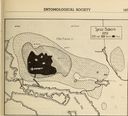
Recorded from Alberta, Manitoba, and Saskatchewan in Canada. Distribution likely extends into adjacent northern United States based on plant range, though specific records are sparse.
Diet
Larvae feed internally within spruce needles, mining between the needle surfaces. Specific feeding mechanism creates characteristic hollowed needles.
Host Associations
- Picea - spruce including white spruce, black spruce, and Engelmann spruce
Life Cycle
Larvae develop within spruce needles, in mined needles. occurs within the needle mine or in adjacent protected locations. emerge in spring to early summer. Specific timing varies with latitude and elevation.
Behavior
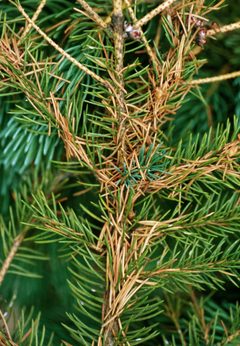
Larvae are concealed feeders, remaining within spruce needles throughout development. Mining activity causes needles to turn brown and may cause noticeable defoliation in heavy . are and attracted to light.
Ecological Role
Herbivore specializing on spruce. Acts as a secondary consumer in coniferous forest . Provides food source for and other natural enemies.
Human Relevance
Occasional pest of spruce in forestry and Christmas tree operations. Defoliation is usually minor but can be locally significant. Not a major economic pest.
Similar Taxa
- Coleotechnites spp.Also small with needle-mining larvae on conifers; distinguished by different associations and larval mine characteristics.
- Other Olethreutinae on spruceRequire genitalia examination or larval rearing for definitive identification; specificity and mine aid field separation.