
Celypha cespitana
(Hübner, [1814-1817])
Celypha Moth
Celypha cespitana is a small tortricid with a wingspan of approximately 15 mm, distributed across the Palearctic and Nearctic realms. The exhibits variable forewing coloration ranging from silvery-white to ochreous, greyish, or reddish tones with distinctive dark markings. are active from late May through September in western Europe. The larvae feed on herbaceous plants, though specific associations remain incompletely documented.
Pronunciation
How to pronounce Celypha cespitana: /ˈsɛlɪfə sɛspɪˈtɑːnə/
These audio files are automatically generated. While they are not always 100% accurate, they are a good starting point.
Identification
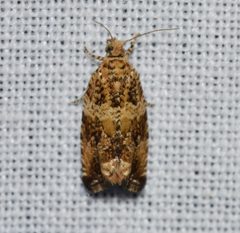
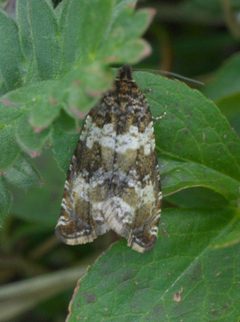
Distinguished from Celypha doubledayana by the less arched and more oblique termen of the forewing. The angularly indented edge of the basal patch and the two sharp projections of the central fascia are diagnostic. Variable ground coloration requires comparison with series specimens for reliable identification.
Images
Appearance
Small with wingspan approximately 15 mm. Palpi porrected with second joint broadly scaled and terminal joint very short. Forewings with less arched than in Celypha doubledayana and termen more oblique. Ground color silvery-whitish, strigulated with variable tones of ochreous, greyish ochreous, reddish, or dark fuscous. Costa marked with black. Basal patch with angularly indented edge. Central fascia with two sharp projections. Oblique praetornal spot and triangular terminal patch both ochreous or ferruginous, mixed with black or dark fuscous. Hindwings uniformly grey.
Distribution
: western Europe to Ural Mountains, Transcaucasia, Asia Minor, Near East, Iran, Russia (Siberia, Central Asia, Cisbaikal, Tuva, Russian Far East), north-eastern China (Manchuria), Korea, Japan (Hokkaido, Honshu). .
Seasonality
fly from late May to September in western Europe.
Diet
Larvae feed on various herbaceous plants.
Similar Taxa
- Celypha doubledayanaSimilar forewing pattern but differs in shape (more arched in doubledayana) and termen angle (less oblique in doubledayana)
More Details
Taxonomic authority
Originally described as Tortrix cespitana by Hübner in 1814-1817.