
Celypha
Hübner, [1825], 1816
Species Guides
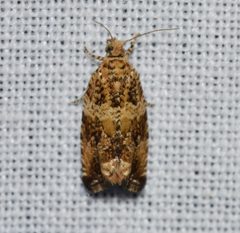
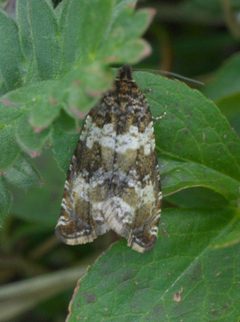
1- Celypha cespitana(Celypha Moth)
Celypha is a of tortrix moths in the Tortricidae, tribe Olethreutini, Olethreutinae. The genus contains approximately 20 recognized and has a predominantly Western Palearctic distribution. The most well-documented species, Celypha lacunana (Common Marble), is among the most common tortrix moths in the British Isles. The genus has a complex taxonomic history with close relationships to Syricoris and Olethreutes, and several junior synonyms including Celyphoides and Loxoterma.
Pronunciation
How to pronounce Celypha: //ˈsɛlɪfə//
These audio files are automatically generated. While they are not always 100% accurate, they are a good starting point.
Identification
Members of Celypha can be distinguished from closely related by genitalia and wing pattern characteristics. The genus is closely related to Syricoris, which is sometimes included within Celypha, and Olethreutes, with which it has historically been confused. -level identification typically requires examination of genitalia; forewing patterns often feature cross bands with distinctive notching or marking patterns. Celypha lacunana specifically shows two creamy or silvery cross bands with a characteristic notch (lacuna) on the outer edge of the inner cross band.
Images
Habitat
in this occupy a wide range of . Celypha lacunana has been recorded from semi-fixed dunes and dune heath, gardens, and various other environments. The genus shows broad habitat across its range.
Distribution
Predominantly Western Palearctic, with records extending from the British Isles (including Western Isles, Shetland, and Orkney) eastward to western Russia and the eastern end of the Black Sea. Few recent records from eastern and western Canada are presumed native. GBIF records also indicate presence in Denmark, Norway, Sweden, and Vermont, USA.
Seasonality
activity varies by . Celypha lacunana adults are on the wing between May and August in Britain. Larvae of this species hatch from August and overwinter as early instars, resuming feeding in spring.
Diet
Larvae feed within folded and spun leaves fastened with silk on a very wide range of herbaceous plants. Specific plant associations vary by .
Life Cycle
In Celypha lacunana, larvae hatch from August and overwinter as early instars, with feeding resuming in spring; emerge May–August. The complete details for other in the are not well documented.
Behavior
of Celypha lacunana can be disturbed during the day but are most active at dusk and through the night, often attracted to light. Behavioral details for other are poorly documented.
Human Relevance
Celypha lacunana is one of the most frequently encountered tortrix moths in the British Isles and serves as a genomic model for the ; a high-quality -level assembly (591.83 Mb) has been published for this .
Similar Taxa
- SyricorisSometimes included within Celypha due to very close morphological and genetic relationship; historical taxonomic treatments vary in generic boundaries
- OlethreutesHistorically confused with Celypha due to similar ; Celyphoides and Loxoterma have been variously treated as synonyms of either , but type analysis confirms them as junior subjective synonyms of Celypha
More Details
Taxonomic Complexity
The has a complicated synonymy history due to its close relationship with Olethreutes. Celyphoides was a for five years (first used by R. Agenjo Cecilia in 1955, properly established by N.S. Obraztsov in 1960). The type of Celyphoides (Tortrix flavipalpana, a junior synonym of C. flavipalpana) and Loxoterma (T. latifasciana, a junior synonym of C. aurofasciana) confirm these as junior subjective synonyms of Celypha in its current delimitation.
Genomic Resources
A -level assembly is available for Celypha lacunana: 591.83 Mb total length, 99.68% scaffolded into 27 chromosomal pseudomolecules, with a 17.21 kb mitochondrial genome (Wellcome Open Research, 2025).