
Grapholita tristrigana
(Clemens, 1865)
three-lined grapholita moth
Grapholita tristrigana, the three-lined grapholita , is a small tortricid moth native to eastern and central North America. The is known to complete multiple per year, with active from spring through fall. Larvae develop internally in the seed pods of leguminous plants.
Pronunciation
How to pronounce Grapholita tristrigana: /ɡrəˈfɒlɪtə trɪˈstrɪɡənə/
These audio files are automatically generated. While they are not always 100% accurate, they are a good starting point.
Identification
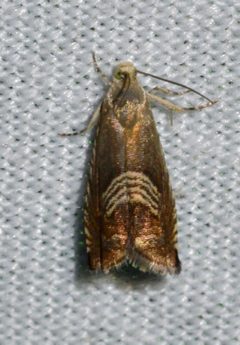
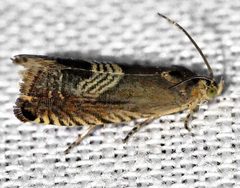
The three dark longitudinal stripes on the forewings are diagnostic for this within the Grapholita. It may be confused with other small Grapholita species, but the specific pattern of three stripes distinguishes G. tristrigana. Dissection of genitalia may be required for definitive identification in some cases.
Images
Appearance
have a wingspan of approximately 13 mm. The forewings display three distinct longitudinal dark stripes, which give the its . Wing coloration is generally brownish with paler markings. The overall body form is typical of small olethreutine tortricids, with a compact body and relatively broad wings held roof-like over the at rest.
Habitat
Associated with open , prairies, and woodland edges where plants in the Baptisia and Lupinus occur. The is found in both natural and semi-disturbed environments supporting leguminous vegetation.
Distribution
Recorded from eastern and central North America: Florida, Georgia, Illinois, Indiana, Maryland, Massachusetts, Missouri, New York, Ohio, Oklahoma, Ontario, and Pennsylvania.
Seasonality
have been recorded on wing from March to October, with peak activity in May and June. This extended period suggests multiple per year.
Diet
Larvae feed internally on seeds within the pods of Baptisia and Lupinus (Fabaceae). feeding habits are not documented.
Host Associations
- Baptisia - larval larvae feed on seeds in pods
- Lupinus - larval larvae feed on seeds in pods
Life Cycle
Larvae develop inside seed pods of plants, feeding on developing seeds. likely occurs in soil or leaf litter, though specific details of the pupal stage are not documented. emerge in spring and continue through fall, indicating overlapping .
Behavior
are and attracted to light. Larvae are endophagous, developing concealed within plant seed pods.
Ecological Role
As a seed of native legumes, this may influence plant reproductive success and in prairie and open woodland . It serves as prey for various .
Human Relevance
Not known to be of significant economic importance. The plants are primarily native not widely cultivated, though some Baptisia and Lupinus species are used in native plant gardening and restoration.
Similar Taxa
- Grapholita prunivoraSimilar small size and general appearance, but G. prunivora has different forewing pattern without three distinct longitudinal stripes and feeds on Prunus (Rosaceae) rather than legumes.
- Grapholita delineanaCongeneric with similar body form, but G. delineana is associated with hemp (Cannabis sativa) and has different distribution and associations; forewing pattern differs.
More Details
Taxonomic history
Originally described by Clemens in 1865. The specific epithet tristrigana refers to the three-striped forewing pattern.
Sources and further reading
- BugGuide
- Wikipedia
- GBIF taxonomy match
- iNaturalist taxon
- Catalogue of Life
- Like a Moth to a Flame: Moth Night at Bohart Museum of Entomology | Bug Squad
- Bohart Museum of Entomology: One Busy Place! | Bug Squad
- Scarab Beetles First to Arrive at UC Davis 'Moth Night' | Bug Squad
- Grapholita delineana Archives - Entomology Today
- IPM in Hemp: Managing Pests in a "New" Crop