
Ecdytolopha insiticiana
Zeller, 1875
Locust Twig Borer, Locust Twig Borer Moth
Ecdytolopha insiticiana, commonly known as the locust , is a small tortricid native to North America. The is an oligophagous on black locust (Robinia pseudoacacia), with larvae that bore into twig pith causing dieback. are active from late spring through summer. The species has been documented as a minor pest in forestry and urban settings where black locust occurs.


Pronunciation
How to pronounce Ecdytolopha insiticiana: /ˌɛk.dɪˈtɒl.ə.fə ˌɪn.sɪ.tɪˈsiː.ə.nə/
These audio files are automatically generated. While they are not always 100% accurate, they are a good starting point.
Identification
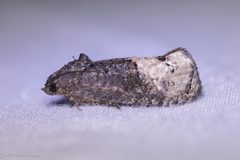
Distinguished from similar tortricids by association with black locust plants and larval boring in twig pith. may be separated from other Ecdytolopha by genitalia examination; E. insiticiana is the only species in the consistently associated with Robinia pseudoacacia. Forewing pattern of gray-brown mottling with distinct darker markings is characteristic but not unique; confirmation requires host association or larval examination.
Images
Appearance
have a wingspan of 20–25 mm. Forewings are mottled gray-brown with darker markings; hindwings are lighter, grayish. Body is compact, typical of Olethreutinae. Larvae are creamy white with a dark brown to black capsule; five larval instars can be distinguished by head capsule width measurements.
Habitat
Deciduous woodlands, forest edges, riparian corridors, and urban plantings where black locust (Robinia pseudoacacia) occurs. Larval is specifically the pith of living twigs, seedlings, and stump sprouts of trees.
Distribution
North America: documented from Ontario, Manitoba, and Saskatchewan in Canada; United States records include Pennsylvania, Iowa, West Virginia, Arkansas, Massachusetts, New York, and Vermont. Distribution corresponds closely to the range of black locust.
Seasonality
are on wing from May to August, with peak activity varying by latitude. Larval development occurs within twigs throughout the growing season.
Diet
Larvae feed exclusively on the pith tissue of black locust (Robinia pseudoacacia) twigs, seedlings, and stump sprouts. No other have been confirmed.
Host Associations
- Robinia pseudoacacia - obligate larval Larvae bore into stem pith of seedlings, stump sprouts, and new stem growth
Life Cycle
Complete with five larval instars. Larvae develop within twig pith, with capsule measurements of 0.30, 0.45, 0.65, 0.95, and 1.35 mm for instars 1–5 respectively. occurs within the gallery or in soil. emerge in spring and summer; number of per year not clearly established from available sources.
Behavior
Larvae are solitary borers in twig pith, creating galleries that cause twig dieback above the feeding site. Larval feeding has been observed to result in flagging of terminal growth. activity assumed based on patterns but not directly documented.
Ecological Role
herbivore on black locust; contributes to twig mortality and crown thinning in trees. Serves as host for in southeastern Kentucky, though specific parasitoid not detailed in available sources.
Human Relevance
Minor pest of black locust in forestry, agroforestry, and urban settings; damage includes twig dieback and reduced growth form. Not considered a major economic pest. Occasionally encountered in horticultural and arboricultural contexts.
Similar Taxa
- Other Tortricidae in OlethreutinaeSimilar size and general appearance; distinguished by association with Robinia pseudoacacia and larval boring habit in twig pith
- Other Ecdytolopha speciesGenitalia and specificity differ; E. insiticiana uniquely associated with black locust
More Details
Larval Instar Determination
capsule width is the definitive character for distinguishing larval instars, with measurements established at 0.30, 0.45, 0.65, 0.95, and 1.35 mm for instars 1 through 5 respectively.