
Eucosma giganteana
(Riley, 1881)
Giant Eucosma Moth
Eucosma giganteana is a North American tortricid and herbivore of Silphium . It has emerged as a major pest threatening the domestication of Silphium integrifolium (silflower), a novel oilseed crop. are active in early to mid-summer, with larvae damaging flower and root crowns. capacity studies show adults can travel 23 km in 24 hours, with peak flight activity in morning hours.
Pronunciation
How to pronounce Eucosma giganteana: /juˈkɔzmə dʒɪˈɡæntiːˌænə/
These audio files are automatically generated. While they are not always 100% accurate, they are a good starting point.
Identification
Distinguished from by its larger size (wingspan 34–38 mm versus smaller Eucosma ) and association with Silphium plants. Field identification relies on host plant presence and timing of in summer. Attraction to (E)-8-dodecenyl acetate in traps may assist detection.
Images
Appearance
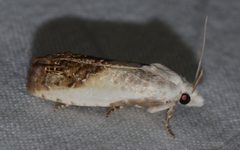
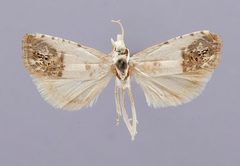
have a wingspan of 34–38 mm. As a tortricid , it has the characteristic bell-shaped wing posture at rest. Specific coloration and pattern details are not documented in available sources.
Habitat
Native North American prairie ; silflower crop fields; agroecosystems with Silphium integrifolium breeding plots. Field sites in Kansas included grasses in inter-rows, surrounded by hardwood windbreaks, intermediate wheat grass, perennial sorghum, and fescue blends.
Distribution
Widespread in the United States from North Carolina south to Florida, west to Minnesota and Texas, with additional records from Pennsylvania, North Dakota, and New Mexico. Native range coincides with native prairies of Silphium .
Seasonality
are on wing in January and from April to September across the range. In Kansas silflower fields, adult occurs primarily June–August, with peak activity in early to mid-summer. Lower activity threshold is 17°C.
Diet
herbivore feeding exclusively on Silphium . Larvae feed on flower (capitula) of Silphium integrifolium and Silphium perfoliatum, then descend to feed on root crowns.
Host Associations
- Silphium integrifolium - primary silflower; novel oilseed crop
- Silphium perfoliatum - primary cup plant
Life Cycle
cycle. emerge in summer (June–July), mate, and oviposit on flower . larvae burrow into flower heads and feed until late summer. Larvae then descend to root crowns in autumn, burrow in, feed, and overwinter as larvae. occurs the following spring, with adult the following summer.
Behavior
exhibit significant attraction to (E)-8-dodecenyl acetate, a potential component. mill assays show adults fly an average of 23 km in 24 hours. Flight is with longest distances in morning (4:00–12:00), 1.8-fold greater than night flights (20:00–4:00). Attractive reduce flight distance by 78–80%, indicating arrestment properties. Both sexes are collected on flowers.
Ecological Role
Native herbivore of Silphium . As a pest of domesticated silflower, reduces seed production by 45–85% in infested and can reach 95% flower head in unmanaged fields. Subject to by and at least one braconid species.
Human Relevance
Major limiting factor to development and commercialization of Silphium integrifolium as a sustainable oilseed alternative. causes seed damage, flower rot, root rot, and long-term plant degradation. Target for -based monitoring and management strategies; growing degree day model developed to guide timing.
Similar Taxa
- Other Eucosma speciesSmaller body size; different associations; (E)-8-dodecenyl acetate attraction may be -specific
- Generalist tortricid mothsE. giganteana is Silphium-specific; lack this strict association
More Details
Pheromone Research
(E)-8-dodecenyl acetate has been identified as a potential component through two years of field trapping studies. This compound shows promise for behaviorally based monitoring and management strategies.
Flight Capacity
Laboratory mill studies demonstrate substantial potential, with capable of flying 23 km in 24 hours under controlled conditions. Morning flight activity peaks suggest optimal timing for monitoring or management interventions.
Economic Impact
In North Dakota nursery plants, eliminated viable seeds entirely. Multi-year heavy infestation causes reduced plant height, , and flower production through cumulative root crown damage.
Sources and further reading
- BugGuide
- Wikipedia
- GBIF taxonomy match
- iNaturalist taxon
- NCBI Taxonomy
- Catalogue of Life
- Field Trapping and Flight Capacity of Eucosma giganteana (Riley) (Lepidoptera: Tortricidae) in Response to Behaviorally Active Congeneric Semiochemicals in Novel Silflower Agroecosystems
- Developing a growing degree day model to guide integrated pest management of Eucosma giganteana, a pest of a novel perennial oilseed crop
- Assessing effective mechanical and chemical strategies for managing Eucosma giganteana (Lepidoptera: Tortricidae) in the perennial oilseed crop, Silphium integrifolium (Asteraceae: Heliantheae).