
Coptotriche badiiella
(Chambers, 1875)
Coptotriche badiiella is a small in the Tischeriidae, known for its leaf-mining larvae that create distinctive blotch mines on oak leaves. The is widely distributed across eastern North America, from Ontario south to Louisiana. Larval feeding is restricted to Quercus species, particularly white oak (Quercus alba) and pin oak (Quercus palustris).
Pronunciation
How to pronounce Coptotriche badiiella: //ˌkɒp.toʊˈtrɪ.ki ˌbeɪ.diˈiː.lə//
These audio files are automatically generated. While they are not always 100% accurate, they are a good starting point.
Identification
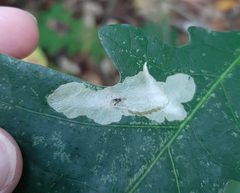
are small typical of Tischeriidae, with narrow, wings. The is most readily identified by its larval leaf mines: ovate (-shaped) blotch mines on the upper surface of oak leaves. Mines begin as linear tracks that expand into pale, irregular blotches, usually with a dark central line of . Similar Coptotriche species on oaks may require examination of genitalia or reared adults for definitive identification.
Images
Habitat
Deciduous forests and wooded areas where oak occur, including urban parks and suburban environments with native oak trees. Associated with both upland and lowland oak given range includes species from varied moisture regimes.
Distribution
Eastern North America: Ontario, Canada; and United States including Connecticut, Illinois, Michigan, Ohio, West Virginia, Arkansas, District of Columbia, Indiana, Kentucky, Louisiana, Maryland, Massachusetts, Missouri, New Jersey, New York, North Carolina, and Pennsylvania.
Diet
Larvae feed exclusively on Quercus , specifically documented on Quercus alba (white oak) and Quercus palustris (pin oak). do not feed; mouthparts are reduced or absent as typical for Tischeriidae.
Host Associations
- Quercus alba - larval white oak
- Quercus palustris - larval pin oak
Life Cycle
Complete with , larva, pupa, and stages. Larvae are leaf miners that feed within oak leaf tissue. occurs within the leaf mine or in soil/litter. Specific timing of and stage not documented in available sources.
Behavior
Larvae are endophagous leaf miners, feeding between the upper and lower of oak leaves. The mine expands from an initial linear track into an ovate blotch as the larva grows. are presumably and attracted to light, as typical for the .
Ecological Role
Primary consumer as larval on oaks. Creates localized damage to individual leaves; -level impacts on tree health not documented. Serves as prey for and other natural enemies of leaf-mining Lepidoptera.
Human Relevance
No significant economic or medical importance. Occasionally encountered by naturalists and leaf mine enthusiasts. Presence indicates intact oak woodland .
Similar Taxa
- Other Coptotriche speciesMultiple Coptotriche mine oak leaves; definitive identification often requires examination or genitalia dissection.
- Tischeria speciesRelated tischeriid also create blotch mines on oaks; distinguished by and mine characteristics.
- Phyllonorycter species (Gracillariidae)Other oak leaf miners with blotch mines, but typically create tentiform mines on lower leaf surface rather than upper surface ovate blotches.
More Details
Leaf mine morphology
The ovate blotch mine is diagnostic among eastern North American oak miners. Fresh mines appear as pale green or whitish translucent patches on the upper leaf surface, with visible accumulation. Mine size increases with larval instar, reaching approximately 10-20 mm in longest dimension.