
Thyris maculata
Harris, 1836
Spotted Thyris, Spotted Thyris Moth
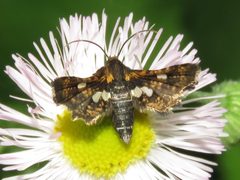
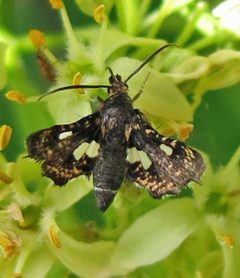
Thyris maculata, commonly known as the spotted thyris, is a window-winged moth in the Thyrididae. It is recognized by the distinctive square or rectangular translucent spots in its wings that give the family its . The exhibits a broad geographic range across North America and has been observed in both eastern and western regions. are and visit flowers for nectar, while larvae are feeders that roll leaves of plants.
Pronunciation
How to pronounce Thyris maculata: /ˈθaɪrɪs ˌmækjuˈleɪtə/
These audio files are automatically generated. While they are not always 100% accurate, they are a good starting point.
Identification
The combination of small size (6-16 mm wingspan) and distinctive square or rectangular translucent spots on the wings separates Thyris maculata from most other . Within Thyrididae, identification to requires examination of specific wing pattern details; T. maculata can be distinguished from the similar T. sepulchralis ('Mournful Thyris') by range and subtle pattern differences. The species is more widespread in the eastern U.S. but occurs in western regions as well. Day-flying and flower-visiting habits may aid in field recognition.
Images
Appearance
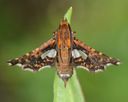
Small with wingspan of approximately 6-16 millimeters. Wings feature characteristic square or rectangular translucent spots that appear white or amber in color. These 'windows' in the wings are the defining trait of the Thyrididae. Overall coloration and pattern details beyond the translucent spots are not well documented in available sources.
Habitat
Found in mixed conifer forest with prairie glades, including areas with Ponderosa Pine and juniper. Has been observed in dry stream beds and areas with sandstone formations. The ' broad plant range suggests adaptability to varied environments where suitable larval food plants occur.
Distribution
North America: Ontario and Quebec (Canada) south and west to Georgia, Texas, Missouri, New Mexico, Colorado, Idaho, and Montana. More widespread in the eastern United States but occurs in western regions including Colorado and the Rocky Mountain area. Records also exist from Alberta, Manitoba, and Saskatchewan in Canada, and from Vermont.
Seasonality
fly from March through October, with peak activity from May through July. Two have been documented in the Pikes Peak region of Colorado, with records from May and August.
Diet
visit flowers for nectar. Larvae are feeders on leaves of plants including Clematis, Houstonia, beans, grapes, cotton, and thoroughworts (Eupatorium). Larvae typically roll leaves and tie them with silk for shelter while feeding.
Host Associations
- Clematis - larval larvae have been reared from this plant
- Houstonia - larval larvae have been reared from this plant
- beans - larval feeding recorded
- grapes - larval feeding recorded
- cotton - larval feeding recorded
- thoroughworts (Eupatorium) - larval feeding recorded
Life Cycle
Complete with , larva, pupa, and stages. Larvae roll leaves of plants and tie them with silk, creating shelters for feeding. Some in the bore in stems or twigs, though this has not been specifically documented for T. maculata. presumably occurs within the larval shelter.
Behavior
(day-flying) distinguishes this from many . visit flowers for nectar. Larvae exhibit leaf-rolling behavior, constructing silk-tied shelters on plants for protection while feeding. Adults have been observed seeking water and minerals at dry stream beds.
Ecological Role
function as when visiting flowers for nectar. Larvae serve as herbivores, feeding on a broad range of plant . The species likely contributes to nutrient cycling through leaf damage and serves as prey for various , though specific documentation is lacking.
Human Relevance
Larvae have been documented feeding on economically important plants including cotton, grapes, and beans, suggesting potential minor agricultural significance. The is encountered by naturalists and enthusiasts due to its habits and distinctive wing pattern. Featured in citizen science initiatives such as National Moth Week.
Similar Taxa
- Thyris sepulchralisAlso in Thyris with similar wing window pattern; distinguished by more mournful appearance and different geographic distribution and preferences. T. sepulchralis has been observed feeding on animal scat as , a not documented for T. maculata.
- Dysodia spp.Larger, heavier-bodied thyridid that are rather than ; attracted to lights rather than observed at flowers during day. Slightly larger size and different activity period aid separation.
More Details
Taxonomic note
The authority is sometimes cited as Harris, 1839 in some databases (NCBI), though Harris, 1836 is the accepted date in Catalogue of Life and GBIF. The MONA or Hodges number for North American classification is 6076.
Family diversity
Thyrididae contains only 12 described in North America, though the is predominantly pantropical with over 760 species worldwide. Over 400 additional species await description at the Natural History Museum, London alone.
Conservation status
Described as 'relatively uncommon' in western North America compared to its abundance in the eastern U.S., though not formally assessed for conservation status.
Sources and further reading
- BugGuide
- Wikipedia
- GBIF taxonomy match
- iNaturalist taxon
- NCBI Taxonomy
- Catalogue of Life
- Bug Eric: Window-winged Moths
- Bug Eric: National Moth Week 2021 Review
- Bug Eric: 2021
- Be careful around baldfaced hornets, Dolichovespula maculata — Bug of the Week
- An inside look at baldfaced hornets, Dolichovespula maculata — Bug of the Week
- High fiber diets for baldfaced hornets? Nah, construction materials for enlarging nests: Baldfaced hornets, Dolichovespula maculata — Bug of the Week