
Thyris
Laspeyres, 1803
window-winged moths
Species Guides
1- Thyris maculata(Spotted Thyris)
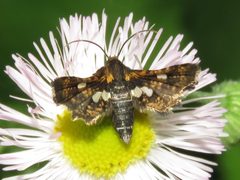
Thyris is a of window-winged moths in the Thyrididae, characterized by distinctive square or rectangular translucent spots in their wings that give the group its . These small, often are primarily pantropical in distribution, with approximately 12 known from North America among over 760 species worldwide. The genus includes species such as Thyris maculata, which ranges widely across North America from Ontario to Georgia, Texas, and west to Colorado, Idaho, and Montana. typically fly between March and October, with peak activity in May through July.

Pronunciation
How to pronounce Thyris: /ˈθaɪrɪs/
These audio files are automatically generated. While they are not always 100% accurate, they are a good starting point.
Identification
Distinguished from other small by the unique window-like translucent spots on the wings—square or rectangular clear areas lacking . May be mistaken for flies when in due to small size and rapid, erratic movement. From other Thyrididae : Thyris are generally smaller and more delicate than Dysodia, which are larger, heavier-bodied, and . Thyris maculata specifically shows spotted wing patterns and is , often visiting flowers.
Images
Appearance
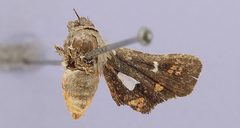
Small with wingspans ranging from 6-16 millimeters in North American . The defining feature is the presence of square or rectangular translucent spots in the wings, which appear white or amber in color. These 'windows' are -free areas that create a distinctive pattern against the otherwise colored wing . The body is relatively compact, and the overall appearance can resemble flies when in due to their small size and rapid movement.
Habitat
Diverse including mixed conifer forest, prairie glades, sandstone bluff areas, and riparian zones. are often found near streams or dry stream beds, possibly seeking water and minerals. Larval habitats depend on plants, which include various herbs, vines, and woody plants.
Distribution
Primarily pantropical distribution with the centered in Old World and New World tropics. In North America, Thyris maculata occurs from Ontario and Quebec south to Georgia, west to Texas, Missouri, Colorado, New Mexico, Montana, and Idaho. Other have more restricted ranges, with some western species like Thyris borealis, Thyris siberica, and Thyris ussuriensis occurring in northern and western regions, and Thyris sinicaensis described from China.
Seasonality
fly from March through October in temperate regions, with peak activity from May through July. In the Pikes Peak region of Colorado, evidence suggests two occur. Some may have bimodal patterns with second appearing in late summer.
Diet
Larvae are feeders on a variety of plants including beans, grapes, cotton, thoroughworts (Eupatorium), Clematis, and Houstonia. They typically roll leaves with silk to form shelters, with some boring in stems or twigs. visit flowers for nectar and have been observed at flowers of golden Alexander (Zizia aurea). Some related species are attracted to animal scat.
Host Associations
- Clematis - larval Thyris maculata reared from this
- Houstonia - larval Thyris maculata reared from this
- Vitis (grapes) - larval General trait
- Gossypium (cotton) - larval General trait
- Eupatorium (thoroughworts) - larval General trait
- Zizia aurea (golden Alexander) - nectar sourceObserved for Thyris maculata
Life Cycle
Complete with four stages: , larva, pupa, and . Larvae construct silk shelters by rolling or tying leaves of plants; some bore into stems. occurs within these shelters. Adults are relatively short-lived and primarily focused on and . Specific details of egg laying and pupal stage duration are not well documented for most species.
Behavior
Many are and active during daylight hours, unusual for . are rapid, erratic fliers that can be difficult to approach and photograph. They frequently visit flowers for nectar. When disturbed, they may quickly take and relocate. Some related species in the are attracted to and other decaying organic matter.
Ecological Role
Larvae function as herbivores, consuming leaves and occasionally boring in stems of various plants; their feeding habits suggest they are not major pests of any single crop. serve as when visiting flowers. They likely serve as prey for various including birds, spiders, and predatory insects.
Human Relevance
Generally of minimal direct economic importance. The 's larval feeding includes some agricultural plants (beans, cotton, grapes), but damage is typically minor. Primarily of interest to lepidopterists and naturalists. Serve as indicators of quality in prairie and forest edge . The distinctive wing windows make them popular subjects for macrophotography.
Similar Taxa
- DysodiaAnother of Thyrididae, but Dysodia are larger (slightly), heavier-bodied, , and attracted to lights rather than being flower visitors
- Sesiidae (clearwing moths)Also have partially transparent wings and can be mistaken for or flies, but Sesiidae have more extensive wing transparency and different body proportions; they are wasp mimics with narrow wings and yellow banding
- Small Diptera (flies)Similar size and pattern; distinguished by wing structure (two wings in flies vs. four scaled wings in , though are reduced in window areas) and structure
More Details
Taxonomic diversity
The Thyrididae contains over 760 described worldwide, with more than 400 additional species awaiting description at the Natural History Museum in London alone. Only about 12 species occur in North America, representing a small fraction of global diversity.
Etymology
The 'window-winged moths' directly references the translucent wing spots. The name Thyrididae and name Thyris derive from Greek roots related to windows or doors, reflecting this diagnostic feature.
Research opportunities
Many remain poorly known, with undescribed species present even in relatively well-studied regions like the southwestern United States. The function of the translucent wing windows—whether for , confusion, or other purposes—remains speculative and unstudied.