
Pseudothyris sepulchralis
(Boisduval, 1832)
Mournful Thyris Moth, Mournful Thyris
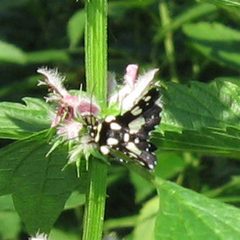
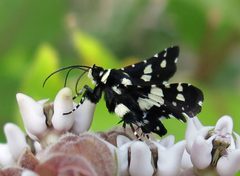
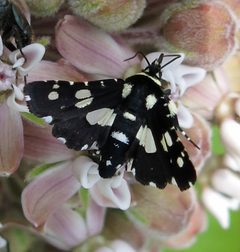
Pseudothyris sepulchralis, commonly known as the mournful thyris, is a day-flying in the Thyrididae distributed throughout North America. have a brief period lasting 2–3 weeks and are rarely observed feeding on flowers. The exhibits distinctive black coloration with white markings. Larvae develop on Smilax species and construct unique leaf-roll cocoons for and .
Pronunciation
How to pronounce Pseudothyris sepulchralis: //ˌsuː.doʊˈθaɪ.rɪs sɛˌpʌlˈkræl.ɪs//
These audio files are automatically generated. While they are not always 100% accurate, they are a good starting point.
Identification
Distinguished from other North American Thyrididae by combination of small size (15–23 mm wingspan), black body with white spotting, and activity pattern. The specific epithet 'sepulchralis' (meaning funeral-like or gloomy) references the dark coloration. Similar in the may share window-winged appearance but differ in color pattern and size.
Images
Habitat
Associated with supporting larval plants (Smilax ). occur in varied environments across North American range. Specific microhabitat preferences for adults poorly documented; rarely found on flowering plants.
Distribution
Throughout North America. Documented records include Canada (Manitoba, Saskatchewan) and United States (Vermont and broadly across the continent).
Seasonality
duration 2–3 weeks. Specific timing varies across range; generally active during warmer months. Single per year with pupal in leaf-roll cocoons.
Diet
Larvae feed on Smilax (greenbriers/catbriers). feeding habits poorly known; rarely observed on flowers, suggesting limited or specialized adult feeding.
Host Associations
- Smilax - larval food plantLarvae feed on Smilax ; specific species not documented in available sources
Life Cycle
Complete . Larva feeds on plant, then cuts an almost perfect circle into a leaf, rolls itself within the leaf piece to form a pouch-shaped cocoon, and overwinters as pupa within this structure until the following year. emerge for brief 2–3 week period.
Behavior
Day-flying activity unusual for . rarely found on flowering plants for feeding, suggesting non-nectar or limited feeding . Larval leaf-cutting and rolling behavior for cocoon construction is distinctive.
Ecological Role
Larval herbivore on Smilax . Role in otherwise poorly documented. interactions with (pollination, ) not well established.
Human Relevance
No documented economic importance. Occasionally noted in entomological collections. 'mournful thyris' reflects coloration rather than any negative association.
Similar Taxa
- Other Thyrididae speciesShare characteristics of window-winged moths; distinguished by size, color pattern, and habit
More Details
Taxonomic History
Described by Boisduval in 1832. The Pseudothyris is small and morphologically distinctive within Thyrididae.
Collection Notes
may be encountered during daytime periods. Larvae may be found by examining Smilax leaves for characteristic circular cuts and rolled leaf cocoons.