
Aglossa cuprina
Zeller, 1872
grease moth
Aglossa cuprina, commonly known as the grease , is a pyralid moth described by Philipp Christoph Zeller in 1872. It is a widespread stored product pest whose larvae feed on dried grain products, while consume grease, suet, and butter. The has gained attention in due to observations of adults feeding on human remains. Its is temperature-dependent, potentially spanning one to two years.
Pronunciation
How to pronounce Aglossa cuprina: /əˈɡlɒsə ˈkjuːprɪnə/
These audio files are automatically generated. While they are not always 100% accurate, they are a good starting point.
Identification
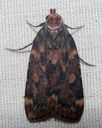
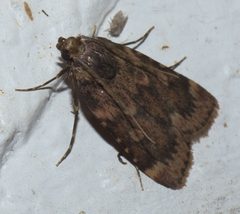
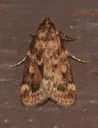
Distinguished from similar Aglossa by larval setal differences; separable from Pyralis farinalis by forewing pattern and overall darker coloration. The tabby-like forewing markings and pale yellow are distinctive. Larvae with black and peritreme separate from A. caprealis.
Images
Habitat
Strongly associated with human habitation, particularly kitchens, pantries, warehouses, grain elevators, stables, outhouses, barns, and cellars. Prefers dark, secluded environments for larval development.
Distribution
distribution spanning Europe, Asia, Australia, North America, and South America. In North America, recorded throughout eastern United States and in California, Arkansas, Arizona, Connecticut, District of Columbia, Delaware, Florida, Illinois, Massachusetts, Maryland, Missouri, North Carolina, New Hampshire, New Jersey, New York, Pennsylvania, South Carolina, Texas, and Wisconsin.
Seasonality
period May through August, with peak activity in early summer. Adults fly at dusk.
Diet
Larvae feed on dried grain-based products including corn meal, whole wheat flour, graham flour, granola, and dried oats. feed on butter, suet, grease, and have been observed on excrement and dried insect remains.
Life Cycle
laid on overhanging supports; hatch in 2–14 days depending on temperature. Larval stage lasts 2–41 weeks, constructing flexible tubular galleries supported by silk. Prior to , larvae disperse and create loose silken coverings interwoven with nearby materials. Total ranges from approximately twelve months to over two years depending on temperature conditions. emerge in early summer. Research on complete life cycle details remains incomplete, with observations inferred from related A. caprealis.
Behavior
fly at dusk and hide in dark corners during daylight hours. Attracted to light and sugar. Larvae create silken galleries and produce silk that interweaves with food products.
Ecological Role
Stored product pest that renders infested grain products unsellable through silk . May play emerging role in as a carrion-associated .
Human Relevance
Major pest of stored grain products in warehouses and domestic settings. Subject of research in following observations of feeding on human remains. Stored product entomologists advise producers on prevention to maintain food defect action levels.
Similar Taxa
- Aglossa caprealisClosely related with similar and preferences; distinguished by larval setal differences
- Pyralis farinalisClosely related , commonly associated due to similar ; A. cuprina distinguished by darker coloration and tabby-like forewing pattern
Sources and further reading
- BugGuide
- Wikipedia
- GBIF taxonomy match
- iNaturalist taxon
- NCBI Taxonomy
- Catalogue of Life
- Learning About the Importance of Blow Flies Through Maggot Art | Bug Squad
- Bohart Museum Features UC Davis Forensic Entomologist Bob Kimsey | Bug Squad
- Lucilia-cuprina - Entomology Today
- Crapemyrtle Aphid: A Cosmopolitan Pest of a Popular Ornamental Tree
- Researchers Sequence Genome of the Australian Sheep Blowfly
- crapemyrtle aphid natural enemies - Entomology Today