
Aglossa caprealis
(Hübner, [1809])
Stored grain moth
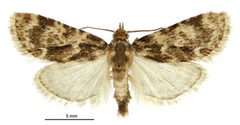
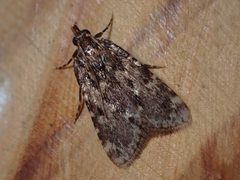
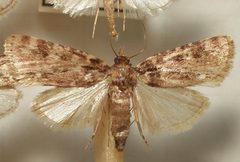
Aglossa caprealis, commonly known as the stored grain , is a pyralid moth of presumably western Palearctic origin that has achieved global distribution through human commerce. are small moths with a wingspan of 23–27 mm, flying during summer months. The is notable for its remarkably broad larval diet, which extends beyond typical stored products to include decaying organic matter and fatty animal materials.
Pronunciation
How to pronounce Aglossa caprealis: /əˈɡlɒsə kæpˈriːəlɪs/
These audio files are automatically generated. While they are not always 100% accurate, they are a good starting point.
Identification
Distinguished from other small pyralid moths by combination of size (23–27 mm wingspan), dull uniform coloration, and association with stored products or decaying organic matter. Similar in Aglossa require genitalia examination or molecular analysis for reliable separation. may be confused with other stored product pyralids such as Pyralis farinalis, but A. caprealis tends to have narrower, more elongate forewings.
Images
Appearance
Small with wingspan 23–27 mm. Forewings relatively narrow, typically with dull brownish or grayish coloration. Hindwings paler, more translucent. Body slender, with long . Resting posture with wings folded tent-like over body.
Habitat
Strongly associated with human-modified environments: grain storage facilities, barns, stables, and areas with accumulated dry organic debris. Larval includes stored grain, hay, straw, and decaying manure piles. Has been observed in caves and other dark, humid situations with organic accumulation.
Distribution
distribution due to human transport; presumed native to western Palearctic or nearby western Eurasian regions. Established documented across Europe, North America, and other continents. GBIF records include Azorean islands (Faial, Graciosa, Pico, São Miguel, Santa Maria).
Seasonality
period June to August in temperate regions; timing varies with latitude and local climate. Multiple per year possible in favorable conditions, with activity potentially extending beyond core summer months in warmer climates or heated storage environments.
Diet
Larvae feed on dry plant waste, grain (including maize), hay, and straw. Also consume decaying manure. Documented consumption of animal-derived materials including carcasses, suet, lard, and pork rinds. This broad diet, spanning plant and animal matter, is unusual among pyralid moths.
Life Cycle
Complete with , larva, pupa, and stages. Larvae develop within or upon food substrate; occurs in silken cocoon within food material or nearby crevices. time variable depending on temperature and food quality; multiple generations annually under optimal conditions.
Behavior
activity. Larvae are scavengers, feeding within or upon accumulated organic substrates. Tendency to inhabit dark, undisturbed locations with food accumulation. Adults attracted to light.
Ecological Role
Decomposer and scavenger in both natural and anthropogenic environments. Contributes to breakdown of dry plant matter and decaying organic material. In stored product , functions as pest and decomposer simultaneously.
Human Relevance
Significant pest of stored grain and dry stored products. Larval feeding reduces food quality and contaminates products with and silk. Economic impact in agriculture and food storage industries. Unusual dietary breadth includes fatty animal products, potentially creating nuisance in meat storage or rendering facilities.
Similar Taxa
- Pyralis farinalisSimilar size, coloration, and stored product ; P. farinalis has broader, more triangular forewings and different wing pattern
- Other Aglossa speciesRequire genitalia dissection or molecular markers for definitive identification; A. caprealis is the most widespread and commonly encountered member of
More Details
Dietary breadth
The larval diet of A. caprealis is exceptionally broad for a pyralid , encompassing both plant and animal matter. This dietary flexibility likely contributes to its distribution and success in diverse environments.
Taxonomic history
has undergone numerous name changes and synonymizations since original description as Pyralis caprealis by Hübner in 1809. Several lapsus calami (cuprealis, cuprialis) appear in literature.