
Vitula edmandsii
Packard, 1865
Dried Fruit Moth, American Wax Moth, Dried-fruit Moth
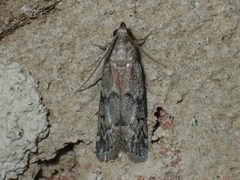
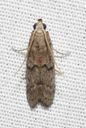
Vitula edmandsii, commonly known as the Dried Fruit or American Wax Moth, is a snout moth in the Pyralidae. The was described by Packard in 1865 and exhibits a transatlantic distribution, occurring in both Europe and North America. It comprises two recognized : the nominate V. e. edmandsii in Europe and eastern North America, and V. e. serratilineella (beehive honey moth) in western North America. The latter subspecies is sometimes treated as a full species due to ecological and geographic distinctions.
Pronunciation
How to pronounce Vitula edmandsii: /vɪˈtjuːlə ɛdˈmændzi.aɪ/
These audio files are automatically generated. While they are not always 100% accurate, they are a good starting point.
Identification
Distinguished from the similar bearer Cadra calidella (another dried fruit ) by taxonomic placement in Vitula rather than Cadra. The serratilineella can be separated from the nominate subspecies by geographic occurrence in western North America and association with beehives. Definitive identification requires examination of genitalia or molecular analysis.
Images
Appearance
Small with a wingspan of 20–25 mm. As a member of Pyralidae, it possesses the characteristic elongated labial palps forming a snout-like projection. Specific coloration and pattern details are not documented in available sources.
Distribution
Occurs in Germany, Denmark, Fennoscandia, Great Britain, and eastern North America. The V. e. serratilineella is restricted to western North America (British Columbia, Washington, Utah, California, Arizona, Texas). GBIF records confirm presence in Manitoba (Canada), Germany, Norway, and Sweden.
Diet
Larvae of the serratilineella are known to infest beehives, feeding on honey and wax. The nominate subspecies has been associated with dried fruit, though specific larval records require verification.
Host Associations
- Apis mellifera - exploitationBeehive honey moth (serratilineella) infests honeybee colonies
Behavior
The western serratilineella exhibits specialized as a beehive pest, infiltrating colonies to access honey and wax resources.
Ecological Role
As a beehive pest, the serratilineella may impact honeybee colony health and productivity. The broader ecological role of the nominate subspecies in natural systems is not documented.
Human Relevance
The V. e. serratilineella is recognized as a pest of honeybee colonies, causing economic concern for beekeepers. The shares its with Cadra calidella, creating potential confusion in agricultural pest management contexts.
Similar Taxa
- Cadra calidellaShares the 'dried fruit '; distinguished by -level classification and likely different geographic distribution patterns
- Vitula edmandsii serratilineellaSometimes treated as full ; occurs in western North America versus eastern distribution of nominate , and specialized on beehives versus general dried fruit association
Misconceptions
The 'American Wax ' is sometimes applied to this , though the true wax moth (Galleria mellonella) is a different pyralid species. The name 'dried fruit moth' is shared with Cadra calidella, potentially causing identification errors in stored product pest management.
More Details
Taxonomic Uncertainty
The status of serratilineella remains unresolved, with some authorities treating it as a full (Vitula serratilineella) rather than a of V. edmandsii. This reflects ongoing debate about species boundaries in the .
Nomenclatural History
Originally described as Nephopterix edmandsii by Packard in 1865, later transferred to Vitula.