
Moodna ostrinella
Clemens, 1860
Darker Moodna Moth
Moodna ostrinella is a of snout moth in the Pyralidae, first described by Clemens in 1860. It is one of several species in the Moodna, a group of small characterized by elongated labial palps that form a snout-like projection. The species is broadly distributed across eastern and central North America, with records extending from Canada to the southern United States.
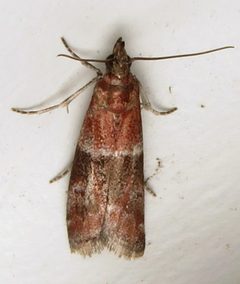
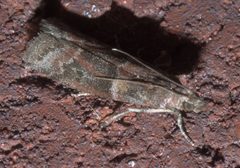
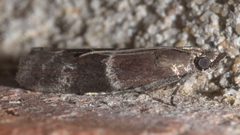
Pronunciation
How to pronounce Moodna ostrinella: //ˈmuːdnə ˌɑstrɪˈnɛlə//
These audio files are automatically generated. While they are not always 100% accurate, they are a good starting point.
Identification
The combination of small size, snout-like labial palps, and brownish-gray forewings with a discal spot distinguishes this from many other small . Within the Moodna, M. ostrinella is generally darker than the related M. pallidostrinella (paler moodna moth), which has lighter, more yellowish-tinged forewings. Genitalia examination may be required for definitive identification of some specimens. Superficially similar to other small pyralid moths in Phycitinae, but the specific wing pattern and coloration aid recognition.
Images
Appearance
Small with wingspan approximately 15-20 mm. Forewings brownish-gray with variable darker markings; pattern includes a distinct discal spot and often a faint postmedial line. Hindwings pale gray, unmarked or nearly so. Labial palps elongated and projecting forward, forming the characteristic "snout" of Pyralidae. Body slender, matching forewing coloration.
Habitat
Found in diverse terrestrial including deciduous and mixed forests, woodland edges, fields, and suburban areas. Larval habitat requirements are poorly documented but likely associated with decaying plant matter or fungi given related ' habits.
Distribution
Eastern and central North America. Canadian records: Ontario, Quebec, New Brunswick, Alberta, Manitoba, Saskatchewan. United States records: Alabama, Florida, Illinois, Maine, Maryland, Massachusetts, Michigan, Minnesota, New Jersey, New York, Ohio, Oklahoma, Pennsylvania, South Carolina, Tennessee, Texas, Vermont, West Virginia.
Seasonality
have been recorded from March through November in various parts of the range, with peak activity varying by latitude. Multiple likely occur annually in southern portions of the range; fewer generations probable in northern areas.
Behavior
are and attracted to light. Resting posture typical of Pyralidae, with wings folded tent-like over the body and snout projecting forward.
Human Relevance
No documented economic importance. Occasionally encountered by enthusiasts at light traps. Not known to be a pest of crops or stored products.
Similar Taxa
- Moodna pallidostrinellaSimilar size and but distinguished by paler, more yellowish-tinged forewings; often requires genitalia examination for confident separation
- Other PhycitinaeMany small pyralid moths share general appearance; M. ostrinella identified by specific wing pattern with discal spot and overall darker coloration