
Arcola malloi
Pastrana, 1961
alligator weed stem borer, Alligatorweed Stem Borer
Arcola malloi is a snout moth used as a agent against the aquatic plant alligator weed (Alternanthera philoxeroides). Native to South America, it was introduced to the United States in the 1970s and is now established in the southeastern United States. The species is notable for its stem-boring larval that destroys plant stems from the inside. When present alongside the alligator weed flea beetle, the two species act synergistically to eliminate weed mats.
Pronunciation
How to pronounce Arcola malloi: /ˈæɹkələ ˈmæloʊ.aɪ/
These audio files are automatically generated. While they are not always 100% accurate, they are a good starting point.
Identification
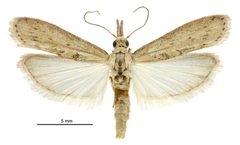
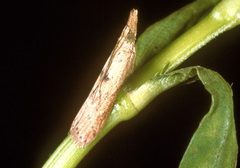
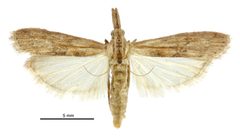
Distinguished from similar snout moths by its association with alligator weed and its specific elongated arrowhead-shaped body. The brown coloration and small size (13 mm) are consistent features. Larvae are initially white upon , quickly turning brown with striping.
Images
Appearance
is brown with an elongated arrowhead shape, approximately 13 millimeters in length.
Habitat
Aquatic and wetland environments where alligator weed (Alternanthera philoxeroides) grows. Associated with mats of this aquatic plant.
Distribution
Native to South America. Introduced to the United States in the 1970s; now established in the southeastern United States, particularly in the Lower Mississippi Valley region.
Diet
Larva feeds internally on stems of alligator weed (Alternanthera philoxeroides), consuming plant tissue from the inside out.
Host Associations
- Alternanthera philoxeroides - primary alligator weed; larval feeding destroys stems and blocks nutrient flow, causing leaf death
Life Cycle
Female lays 200-300 white during her approximately one-week lifespan. Larva emerges white, quickly turns brown with striping, then bores into alligator weed stems. Larva destroys 4-8 stems before pupating. occurs within a cocoon inside hollowed-out stems for approximately ten days.
Behavior
Larva exhibits stem-boring , tunneling into alligator weed stems and consuming internal tissue. When co-occurring with the alligator weed flea beetle, the two demonstrate synergistic effects, with weed mats rarely recovering from combined .
Ecological Role
agent for alligator weed. Larval feeding destroys plant stems, blocking nutrient flow and causing death of plant tissue. Heavy can eliminate mats of alligator weed.
Human Relevance
Intentionally introduced to the United States in the 1970s as a agent against the noxious aquatic plant alligator weed. Now an established component of integrated weed management programs in the southeastern United States.
Similar Taxa
- alligator weed flea beetleco-occurs on alligator weed mats; distinguished by being a (Coleoptera) rather than , with different feeding damage (foliar vs. stem-boring)