
Palpita flegia
Cramer, 1777
satin white moth, Satin White Palpita
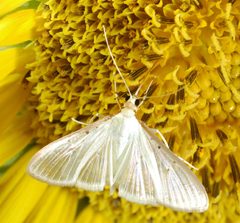
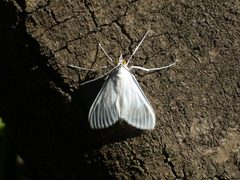
Palpita flegia is a crambid commonly known as the satin white moth. It was described by Cramer in 1777 and has a broad distribution across the Neotropics and into the southern United States. The is a documented pest of ornamental plants in the Apocynaceae, particularly Cascabela thevetia. Laboratory studies have established detailed parameters including six larval instars and specific thermal requirements for development.
Pronunciation
How to pronounce Palpita flegia: /pælˈpiːtə ˈflɛdʒɪə/
These audio files are automatically generated. While they are not always 100% accurate, they are a good starting point.
Identification
Distinguished from similar Palpita by combination of size, geographic occurrence, and association with Apocynaceae plants. The specific epithet and white satiny appearance are referenced in . Accurate identification to species level may require examination of genitalia or molecular markers.
Images
Appearance
wingspan approximately 46 mm. Overall coloration white with satiny appearance. Wing pattern details not explicitly described in available sources.
Habitat
Urban and suburban environments where plants are cultivated. Associated with human-modified landscapes containing ornamental Apocynaceae.
Distribution
Native to Mexico. Recorded from Suriname, Colombia, Brazil, Honduras, Nicaragua, Rica, Panama, the Caribbean, and the United States (Alabama, Florida, Texas). Also documented in Santiago del Estero, Argentina.
Seasonality
increases observed during autumn in regions with average temperatures of 15°C and relative humidity of 60-75%. activity and timed to coincide with favorable thermal conditions.
Diet
Larvae feed on foliage of Cascabela thevetia (L.) Lippold (Apocynaceae), also known as Thevetia peruviana. Specific feeding on leaves; no other plants documented.
Host Associations
- Cascabela thevetia (L.) Lippold. - larval plantprimary ; also known as Thevetia peruviana
- Thevetia peruviana Schumann - larval plantsynonymous with Cascabela thevetia
Life Cycle
Complete with six larval instars. Larval phase lasts 25 days. Pupal phase lasts 16 days. survival averages 5 days. Total biological cycle requires 403.52 degree days. Development occurs under laboratory conditions at specified temperatures.
Behavior
Larvae are folivorous, causing visible defoliation of plants. have brief lifespan focused on . strongly influenced by temperature and humidity, with autumn peaks in activity.
Ecological Role
Herbivore and documented pest causing defoliation of ornamental plants. Subject to by pupal Brachymeria flegiae (Hymenoptera: Chalcididae). Natural enemies contribute to .
Human Relevance
Recognized pest of ornamental Thevetia in . Sanitary pruning recommended as management practice. Conservation of natural enemies, particularly Brachymeria flegiae, indicated for .
Similar Taxa
- Other Palpita species Palpita contains multiple similar white or pale-colored crambid ; accurate separation requires detailed morphological or molecular analysis
More Details
Thermal Biology
Laboratory studies quantified precise thermal requirements: 403.52 degree days required for complete development. This parameter enables prediction of timing based on climate data.
Parasitoid Association
Brachymeria flegiae Burks, 1960 (Hymenoptera: Chalcididae) is a verified pupal . This -specific natural enemy represents a potential agent.
Nomenclatural History
Originally described as Phalaena flegia Cramer, 1777; later transferred to Palpita. Basionym reflects historical classification in broader Phalaena concept.